Baby ID Bracelet: How to Choose It, Engrave It, and When to Gift It
Gold or silver, wrist size, first name engraving, when to gift it: the ultimate guide to choosing a baby or christening ID bracelet with confidence.
This article contains affiliate links: if you buy after clicking, Orzyla may earn a commission at no extra cost to you.
Aurelia
31 July 2026
A baby identification bracelet is the first piece of jewelry engraved with the name of someone who cannot yet write their own.
“A first name is engraved on a bracelet long before the child knows how to read it. It is a gift offered to the adult they will one day become.”
It is one of the most classic, yet most personal, birth and baptism gifts. Here is how to choose it: the metal, the size of a baby's wrist, the engraving, the right moment to offer it, and who traditionally gives it.
Identification bracelet or ID bracelet: they are the same thing
A word on vocabulary first, as it often creates confusion at the time of purchase.
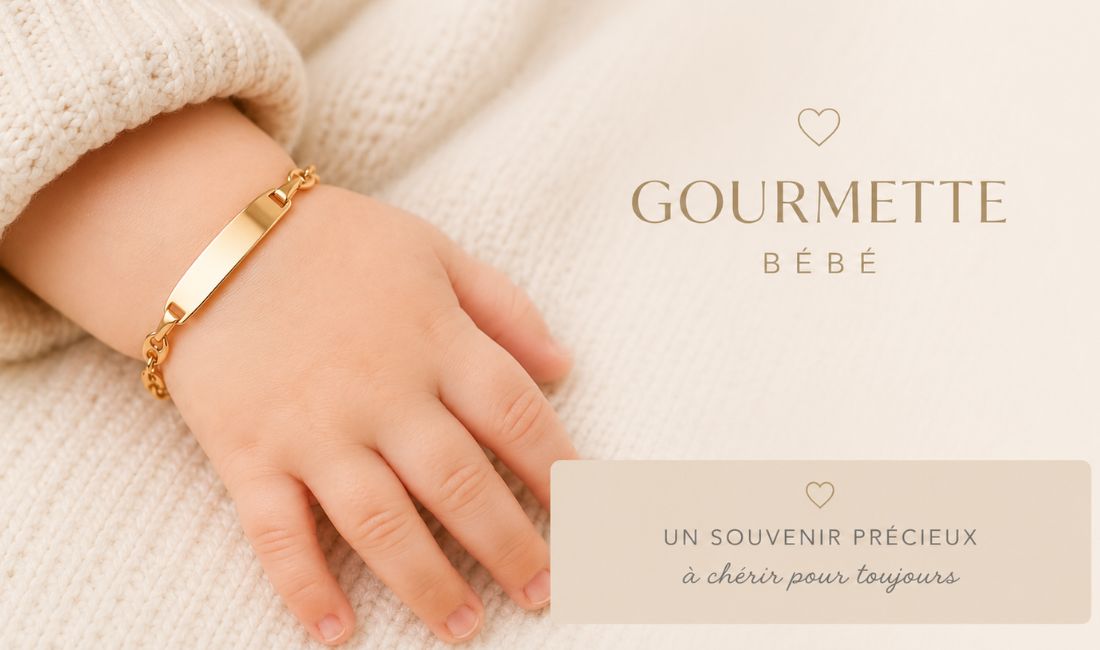
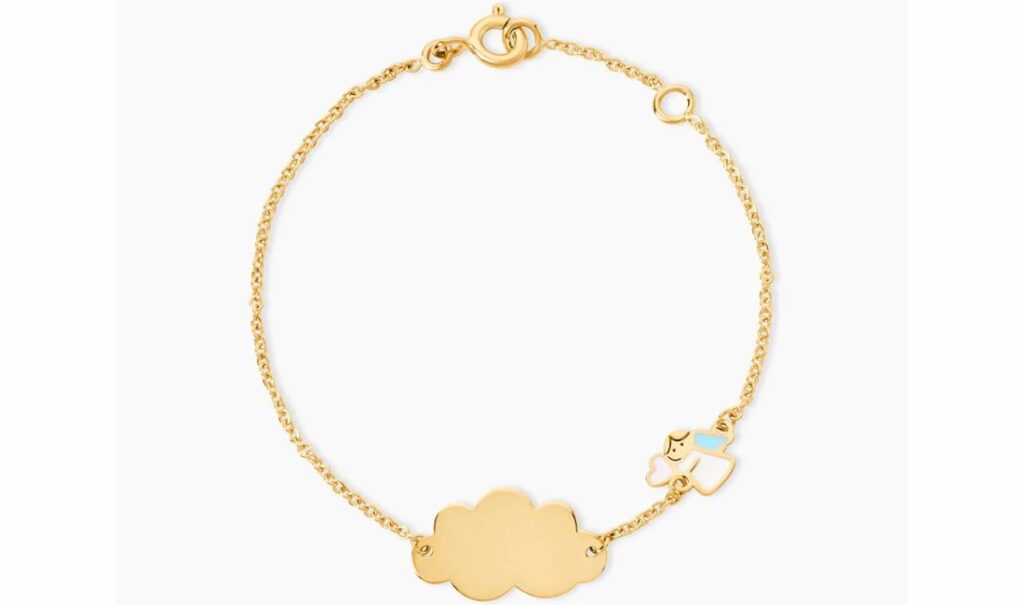
A baby identification bracelet is a flat-link bracelet featuring a central plate intended for engraving. Some jewelry houses call it an “id bracelet,” others an “identity bracelet” or “baby ID bracelet.” It is the exact same object.
The plate is what distinguishes it from a simple bracelet: it is made to receive a first name, a date, and sometimes a few words. An ID bracelet without engraving loses half its meaning.
Who gives the identification bracelet?
As with the medal, tradition partly answers the question.
The baptism medal is traditionally given by the godfather and godmother. The identification bracelet, however, is the classic gift from grandparents. This division avoids duplication: each loved one has their own piece of jewelry to offer, and the child receives a cohesive set.
Nothing requires you to follow this custom. An ID bracelet is also given for a birth, without a baptism, by any family member or close friend. But if you are a grandparent hesitating between a medal and an ID bracelet, the bracelet is traditionally your role.
Yellow gold, white gold, or silver?
The metal is a commitment, because an ID bracelet is kept and passed down.
18-karat yellow gold is the classic choice. It does not oxidize, almost never causes allergies, and safely withstands permanent contact with a baby's skin. It is the safe bet, and by far the most frequently offered.
White gold is more contemporary, but its rhodium plating wears off over time. On a baby identification bracelet that is worn infrequently, this is not an issue.
Silver costs less, but it tarnishes upon contact with skin and sweat, requiring regular cleaning. For a piece of jewelry meant to last and be passed from one child to another, gold remains the more carefree option.
A point that parents often forget: babies' skin is sensitive. 18-karat gold and 925 sterling silver are the two best-tolerated metals. Avoid plated metals and low-end alloys for prolonged contact with an infant's wrist.
What size baby identification bracelet should you choose?
This is the most practical question, and the one that causes the most returns.
The length of a baby identification bracelet generally ranges from 13 to 16 cm. It should drape without being tight: fitted enough so the child does not lose it, loose enough not to leave marks on their skin.
| Age | Bracelet Length | Reference |
|---|---|---|
| Birth to ~1 year | 13 to 14 cm | the wrist is very slender |
| 1 to 3 years | 14 to 15 cm | the most common size |
| 3 years and older | 15 to 16 cm | or adjustable model |
Many models feature an adjustment ring to gain one or two centimeters as the child grows. When in doubt, an adjustable bracelet is the safest choice.
The classic trap: buying too big “so that it lasts.” A bracelet that dangles loosely on an infant's wrist slips, gets in the way, and ends up stored away. It is better to get the right size now, even if it means adjusting it later.
The engraving: what to write
This is the heart of the identification bracelet. The plate is almost always engraved, and this is what makes it a unique keepsake.
What is traditionally inscribed:
- The child's first name on the front of the plate
- The date of birth on the back, or the first name on the front and the date on the reverse
- Sometimes a short word, an initial, a symbol
Two pieces of advice. Check the engraving turnaround time before purchasing: often count one to two weeks, which matters if a baptism or birth is approaching. And think about legibility: on a small plate, a long first name or an overly ornate font becomes unreadable. Simple and clear is best.
You can find engravable gold identification bracelets at Histoire d’Or as well as at Marc Orian, in both yellow and white gold, with a choice of several chain links.
At what age to offer it
The identification bracelet accompanies the early moments of life, but it is not worn at just any time.
For a birth or baptism: this is the classic moment to offer it. The child will not wear it every day right away, but it marks the event and is kept as a treasure.
For everyday wear: many parents wait until the child has passed the phase of putting everything in their mouth before letting them wear it regularly. An identification bracelet is removed for sleeping and bathing.
Later on: some families only bring out the bracelet for special occasions, then pass it down when the child grows up. Others keep it as a memento without ever wearing it for long. Both approaches are valid.
Safety comes first: a quality clasp, never wear an ID bracelet during unsupervised sleep, and regularly check that the size has not become too tight.
The budget
A baby identification bracelet covers a wide price range, depending on the metal, weight, and jewelry house.
- Silver: starting around twenty euros for a simple engraved model.
- 9-karat gold: starting from 50 to 90 € for the bracelet alone.
- 18-karat gold: the core of the market, from 90 to 300 € depending on the weight of the plate and the length.
- Crafted or fine jewelry pieces: beyond that, up to several hundred euros.
Engraving is often included or billed for just a few euros. A benchmark: for a good quality, engraved 18-karat gold identification bracelet, expect to pay between 100 and 300 €. This is a gift meant to be kept for a lifetime, which explains why grandparents gladly take charge of it.
Identification bracelet or medal: which one to offer?
This is the question that arises most often, especially when several family members want to offer a piece of jewelry for the same baptism.
The two do not play the same role. The medal is worn around the neck, is often religious, and traditionally belongs to the godfather and godmother. The identification bracelet is worn on the wrist, is secular by nature, and is the classic gift from grandparents. Nothing prevents you from offering both: they complement rather than compete with each other.
If you must choose, a few guidelines. The medal is more symbolic and more visible in baptism photos. The bracelet is more discreet, more suited for everyday wear, and engraving the first name on the wrist makes it a very personal object. For a religious baptism, the medal often asserts itself naturally; for a birth without ceremony, the ID bracelet is the most natural choice.
A practical point sometimes settles the question: the medal requires a matching chain, meaning a second purchase or a second gift to coordinate. The identification bracelet is complete in itself. For a unique and self-contained gift, it is simpler.
To delve deeper into choosing a medal, its metal, and its motif, see our dedicated guide to the baptism medal.
In a word
The baby identification bracelet is the gift from grandparents, whereas the medal falls to the godfather and godmother. 18-karat yellow gold remains the safe choice, an adjustable size prevents mistakes, and the plate is engraved with a legible first name and date. A first piece of jewelry chosen once, to accompany a lifetime.
Stay connected
To miss nothing of our jewelry, fashion, and accessory trends, guides, and news, follow Orzyla on Facebook, X, and Instagram.
Each month, discover our new arrivals and advice directly in your inbox by subscribing to the newsletter.
Comments
Comments are coming soon.