How to Spot a Counterfeit Bag: Your Guide
Designer handbags hold a unique place in our hearts. Yet this fascination attracts its dark side: counterfeits.
Aurelia
19 October 2025
The market for fake goods is worth several billion euros a year, and modern imitations bear little resemblance to the crude copies of twenty years ago. Today, some can even deceive experienced sellers. Whether you are coveting a Chanel 2.55, an Hermès Birkin, or a Louis Vuitton Speedy, a few precise benchmarks are all it takes to tell the real from the fake. Here they are.
"The authenticity of a bag is not measured by its price, but by the precision of every detail."
Check the Model, Year, and Collection: Every Era Has Its Signature
First and foremost, make sure the model actually exists. Check the brand's official website, archives, and approved resale platforms: cross-reference your findings. Counterfeiters regularly invent "hybrid models" that combine elements from several collections. This is one of the most reliable warning signs of a fake.
Take the Chanel 2.55. Created in February 1955 by Gabrielle Chanel (hence its name), it features a rectangular "Mademoiselle" lock and diamond quilting. Be careful not to confuse it: the double-C clasp everyone knows comes from the reissue signed by Karl Lagerfeld in 1983, known as the "Classic Flap." A seller presenting an "original" 2.55 with a CC clasp is either mistaken or trying to deceive you.
The year of manufacture matters just as much. Every fashion house evolves its materials, clasps, and proportions over the decades. The Hermès Kelly is the prime example: 1950s models featured an angular clasp and rigid box calfskin, whereas recent editions play with softer lines and finer metalwork. A bag sold as "vintage" but featuring modern finishes (or vice versa) betrays an inconsistency. Knowing how to read this chronology means instantly ruling out half of all fakes, tracing the journey of luxury across time.
Stitching: The Mirror of Craftsmanship
A luxury bag is first recognized by its stitching. Three things to look for: regularity (stitches that are aligned and evenly spaced), symmetry (no imbalance from one side to the other), and durability (threads that do not fray). Houses like Louis Vuitton adhere to a precise number of stitches per centimeter depending on the model. Uneven or overly loose stitching should immediately alert you.
Logos and Engravings: A House Signature
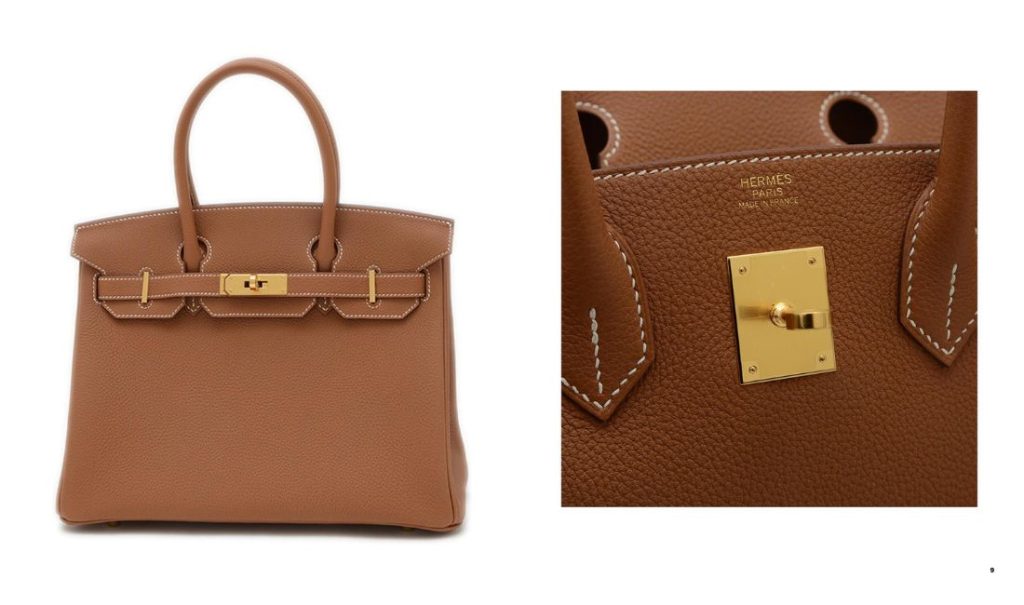
Logos, monograms, and typography remain the guardians of authenticity. The L and V of Louis Vuitton always intertwine perfectly. At Gucci, the two Gs of the logo are identical and aligned. On an Hermès bag, the "Hermès Paris Made in France" engraving is crisp, fine, and centered.
Fakes often feature approximate lettering, uneven spacing, or poorly positioned engravings. Examine the shape, spacing, and depth of the stamping: this is where counterfeiters give themselves away the most.
Materials: Leather, Canvas, and Metal
An authentic bag is felt as much as it is seen. The leather is supple, lightly scented, never plasticized. The coated canvas of Louis Vuitton has a grainy and dense texture. The metals (clasps, rivets, buckles) are heavy and solid.
Weight, precisely, tells a story. Authentic pieces are dense, carefully polished, and have a tangible presence in your hands. Conversely, a hollow, overly light clasp or overly bright gold hardware that tends to look tarnished spells imitation. In the world of luxury, every gram counts.
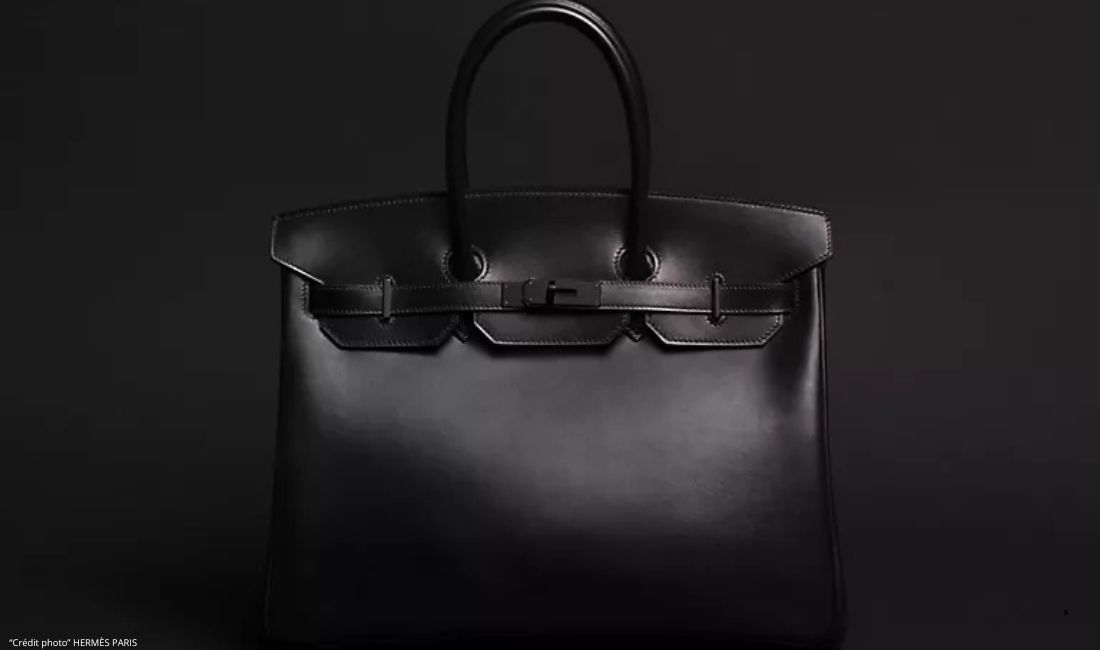
A simple test for a Birkin: a real one maintains its shape, even when empty. If it sags, be suspicious.
Serial Number and "Made in" Tag: The Bag's Identity Card
Every luxury bag bears a form of identity: a number engraved on the inside or hidden on a stitched tag, indicating the place and period of manufacture. Each house has its own system.
At Louis Vuitton, the factory code (used until 2021) is read as follows: two letters for the workshop, followed by four numbers. The 1st and 3rd digits indicate the week of the year, while the 2nd and 4th indicate the year. A code like "SD2119" therefore points to a bag made in the SD workshop (France or the United States) during the 21st week of 2019.
An important point, often overlooked: since March 2021, Louis Vuitton has phased out these codes in favor of an embedded RFID microchip, which is invisible and can only be scanned in-store. The absence of a code on a recent bag is therefore not a sign of a fake—it is the new standard. Do not let yourself be fooled the other way around.
The "Made in" tag deserves equal scrutiny. Font, stitching quality, exact placement: everything is consistent within a single brand. An off-center "Made in Italy" or overly thick stamping is sometimes enough to betray a copy.
One last point, and not the least: a serial number is not proof of authenticity on its own. Counterfeiters reproduce valid codes. It must always be cross-referenced with everything else (materials, stitching, hardware, period consistency).
The Price: A Major Red Flag
A deeply discounted luxury bag is rarely a good deal. Counterfeiters lure buyers in with unrealistic markdowns. The rule can be summed up in a single sentence: if the price seems too good to be true, it probably is.
Professional Authentication: The "Outside-In" Method
This is the approach used by authenticators at major resale platforms. It boils down to a few steps.
Start with the exterior (leather, stitching, logos, metals), then move to the interior (lining, tags, finishes). Well-made fakes often fall short on internal details, which are less meticulously crafted. Next, check period consistency: a supposedly vintage bag with modern finishes is suspect. Study historical signatures, as typography and logos evolve over the years (an early 2000s Balenciaga does not feature the same branding as a recent model). Test the metal and weight: a light or rough clasp rings false. Finally, never rely on the serial number alone.
The true rule, the one that sums it all up: every element must speak the same language. Leather, stitching, hardware, packaging, dust bag. As soon as a single detail feels off, it is a red flag.
Where to Buy with Confidence?
Reliable channels can be counted on one hand: the brands' official boutiques, their e-commerce websites, and resale platforms that authenticate every piece through experts, such as Vestiaire Collective, The RealReal, or Collector Square.
To be avoided, however: anonymous marketplaces and personal accounts on social media, where the vast majority of fakes circulate. Low prices there are almost always a trap.
Anecdotes from the History of Fakes
In the 1980s, the first copies of Louis Vuitton bags were sold on the parallel markets of New York. As early as 1986, Chanel fought back by introducing micro-coded tags to counter fraud. And in 2024, Hermès won a massive lawsuit against an international network counterfeiting the Birkin.
These cases serve as a reminder of one thing: a fake is not merely an aesthetic copy. It is a direct assault on artisanal craftsmanship.
Our Verdict
Spotting a counterfeit bag means learning how to look. The materials, the stitching, the engravings, the proportions, the weight of the metal: each element tells the story of the craftsmanship that brought the bag to life. No imitation can ever replicate that overall cohesion.
By choosing an authentic designer bag, you are not just buying an object. You are buying a history, a gesture, a signature. And that cannot be copied.
Also Read on Orzyla:
- Chloé's Paddington Bag Makes a Triumphant Return
- Marc Jacobs The Editor Bags
- 6 Luxury Bags to Invest In: The Spring-Summer Runway Must-Haves
To authenticate or buy secondhand: Vestiaire Collective · Joli Closet (Pre-owned Hermès) · Birkin on the Official Hermès Website
Related tags
Comments
Comments are coming soon.