Ruby Ring: Choosing the Stone, the Setting, and the Metal
How to choose a ruby ring: intensity of the red, treatments to verify, setting according to lifestyle, and matching with yellow or white gold. The complete guide.
Aurelia
28 July 2026
There are few reds as true and striking as that of a fine ruby. A color that catches the light, commands attention from across the room, and resembles no other gemstone. This explains why rubies continually return to engagement rings, anniversary gifts, and self-purchased treats. The challenge lies in making the right choice, because between two rings of similar price, the difference in beauty can be immense. Here is what makes all the difference.
Everything Revolves Around Color
A ruby is judged first and foremost by the eye. The ideal red is pure, vivid, neither too dark nor leaning toward pale pink. Connoisseurs even have a name for the ultimate shade: "pigeon's blood," a deep tone with a subtle bluish hint, the kind that drives up bids at major auction houses.
Three elements combine. The hue, meaning the shade of red, with a touch of purple in the finest specimens. Saturation, the intensity of the color, which matters the most: a dull ruby will never captivate, no matter its size. Finally, the tone, neither too light nor too dark, residing in that luminous sweet spot where the red remains radiant.
One golden rule to prevent disappointment: examine the stone in daylight, not just under boutique spotlights. Some rubies blaze under sales lighting only to turn lackluster once outside. A truly magnificent stone retains its fire everywhere.
Treatments: What a Reputable Jeweler Will Tell You
A minor topic rarely discussed yet vitally important. Almost all commercial rubies are heated, and this is completely standard: this ancient treatment enhances the color without compromising the stone's integrity, remains undetectable, and detracts nothing from its wearability. A heated ruby is still a genuine, natural gemstone. Nothing to fear here.
Two other treatments deserve your attention. Glass filling conceals fissures in lower-grade stones to make them appealing in shop windows: these stones cost little, yet remain fragile and poorly tolerate shocks or heat. Diffusion colors only the surface layer. Nothing disastrous if the price reflects it, but you must be aware before purchasing.
The best practice: beyond a few hundred euros, request an independent laboratory certificate. A serious jeweler will hand it to you without hesitation.
The Setting Changes Everything
This is often where a ring transforms from "pretty" to "breathtaking." The setting showcases and protects the stone, and the right choice depends entirely on how you intend to wear it.
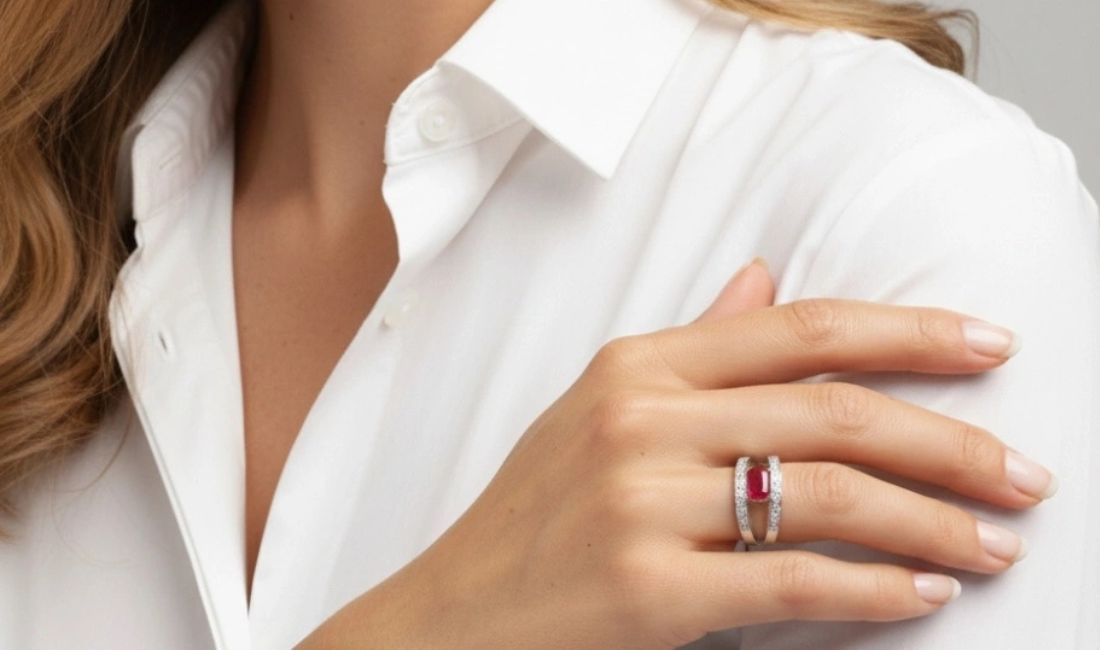
The bezel setting encloses the ruby in a delicate rim of metal: it is the most protective, ideal for a ring you never take off. The prong setting, more classic, allows more light to pass through and makes the stone appear larger, creating a spectacular visual impact. And if you truly wish to make a statement, a halo of small diamonds surrounding the ruby multiplies its brilliance—a guaranteed celebratory jewelry effect.
The best way to decide is to see them for yourself. From the simplest solitaire to a more intricate halo ring, browsing a selection of ruby-adorned rings helps identify the style that speaks to you and demonstrates how the red interacts with different settings and metals. Visualizing is always clearer than words.
For an everyday ring, prioritize durability and a securely held stone. For an exceptional piece or a milestone gift, you can dare something more open, more luminous, and more generous in brilliance.
Yellow or White Gold: The Detail That Makes All the Difference
Many are unaware that the metal alters our perception of the red. This is not merely a cosmetic detail; it transforms the entire character of the ring.
Yellow gold and the ruby complement each other naturally. The result is warm, wonderfully vintage, highly flattering, and the yellow infuses extra warmth into the stone. It is the perfect choice for a slightly lighter or faintly orange-toned ruby, which it envelops to perfection.
White gold and platinum do the exact opposite, with striking results. The cool metal creates a sharp contrast that makes the red appear more vibrant, almost electric. This is the pairing that exalts an intense, highly saturated ruby: nothing competes with its color, allowing it to take center stage. It is also the metal that pairs most harmoniously with diamonds.
And rose gold, rarer still, softens the ensemble beautifully for a romantic, intermediate aesthetic. One final piece of advice worth its weight in gold: try it on your finger. Warmer skin tones generally harmonize better with yellow gold, while fairer complexions suit white gold, and the difference becomes immediately obvious the moment you slip the ring on.
The exact same ruby might captivate you in a photo set in yellow gold yet prove infinitely more convincing in white gold once worn on the hand. The trying-on process is what settles the choice, not the screen.
A Stone Steeped in History
The ruby has fascinated humanity for millennia. In Sanskrit, it was called "ratnaraj," the king of precious stones. Burmese warriors would slip them beneath their skin before battle, convinced they conferred invincibility. In medieval Europe, kings and bishops wore them as symbols of power and divine protection, and they still adorn royal crowns today.
This prestigious reputation stems from more than just rarity. The red of the ruby is the color of blood, fire, and passion. It has long been credited with the power to revitalize energy and fortify courage, remaining in the collective imagination the stone of love and strength. This is undoubtedly why it is gifted when one wishes to convey a powerful message.
Ultimately, this may be the true asset of a ruby ring: it carries a history thousands of years old, and you can feel it the moment you slide it onto your finger.
The Right Choice, in the Right Order
A magnificent ruby ring always begins with the stone: a pure and luminous red, transparent treatments, and a certificate for any piece exceeding a few hundred euros. The setting follows according to lifestyle—protective for daily wear, more open to dazzle. And the metal is chosen to complement the stone: white gold to ignite an intense ruby, yellow gold to enfold a softer hue. Respect this trio in order, and you cannot go wrong. Because a ring that turns heads is never about the largest carat weight, but rather the harmony between the stone, its setting, and the metal.
Stay Connected
To ensure you never miss our trends, guides, and news regarding jewelry, fashion, and accessories, follow Orzyla on Facebook, X, and Instagram.
Each month, discover our latest arrivals and expert advice delivered straight to your inbox by subscribing to our newsletter.
Related tags
Comments
Comments are coming soon.