Egyptian Jewelry: Symbols and Meanings
Discover why Egyptian jewelry still fascinates: explore the main symbols (Eye of Horus, Ankh, scarab), their meanings, and styling tips.
Aurelia
24 September 2026
Jewelry is not merely an accessory designed to complete an outfit. For millennia, pieces have also represented beliefs, symbols, or a certain worldview. Among the civilizations that have particularly left their mark on the history of jewelry, ancient Egypt holds a unique place.
Scarabs, the Eye of Horus, the Ankh cross, and representations of deities continue to inspire designers today. Once found on amulets, pendants, and ornaments, these symbols now adorn contemporary jewelry.
But what do these motifs truly represent, and how can they be incorporated into your style?
Why does Egyptian jewelry still fascinate us today?
Ancient Egypt possesses an immediately recognizable visual identity. Hieroglyphs, representations of pharaohs, deities, and the numerous symbols associated with this civilization have long served as a major source of inspiration.
Jewelry also held a special place there. Beyond its aesthetic appeal, it could be linked to social status, religious beliefs, or a protective function.
It is precisely this symbolic dimension that still distinguishes Egyptian-inspired jewelry from many more conventional accessories today.
Wearing a pendant depicting a scarab or an Eye of Horus is therefore not solely an aesthetic choice: the motif also carries a specific history and meaning.
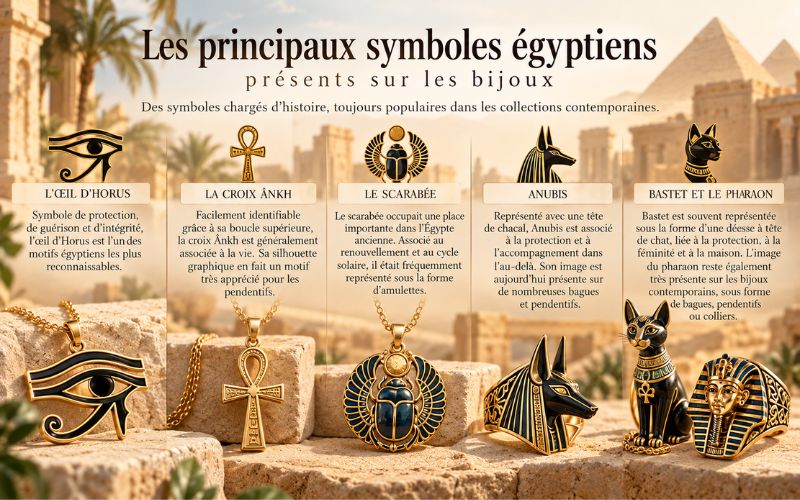
Key Egyptian symbols found in jewelry
Certain symbols transcend eras and remain prominent in contemporary collections.
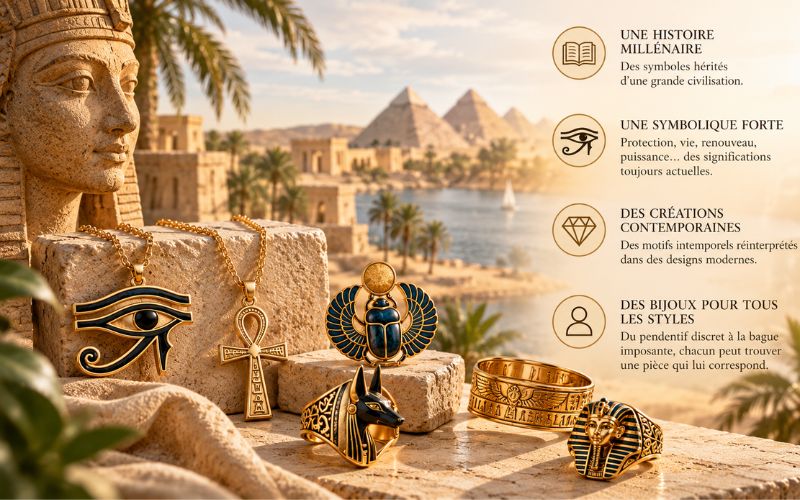
The Eye of Horus is arguably one of the most recognizable. In ancient Egyptian tradition, it was particularly associated with protection, healing, and integrity.
The Ankh cross, easily identifiable by its upper loop, is generally associated with life. Its graphic silhouette also explains why it lends itself particularly well to the creation of pendants.
The scarab also held an important place. Associated notably with renewal and the solar cycle, it was frequently depicted in the form of amulets.
Other figures such as Anubis, Bastet, or the pharaoh are used today on rings, bracelets, pendants, and necklaces to create pieces with a much stronger character.
For those wishing to explore this universe more broadly, a specialized site allows visitors to discover various creations inspired by the symbols, deities, and emblematic figures of ancient Egypt.
How to wear Egyptian-inspired jewelry?
The visual richness of these jewelry pieces can give the impression that they are difficult to style. However, a few simple choices make it easy to incorporate them into a daily wardrobe.
A relatively discreet Ankh pendant, for instance, can be worn with a black, white, or beige outfit. The contrast allows the symbol to become the focal point without overwhelming the ensemble.
Bolder rings depicting a pharaoh, a scarab, or a deity can be worn alone to maintain a certain balance.
It is also possible to play with layering using several delicate pieces. In this case, it is best to maintain consistency in tones and materials so that the various elements work harmoniously together.
Between historical heritage and contemporary trends
Interest in ancient Egypt extends far beyond the realm of archaeology. Its aesthetic has long influenced fashion, interior design, cinema, and fine jewelry.
Contemporary designers may adopt the geometry of ancient symbols while simplifying their lines. An Ankh cross can thus become a minimalist pendant, while the Eye of Horus can be integrated into a more modern ring or bracelet.
This reinterpretation preserves the visual power of the symbol without necessarily replicating historical pieces identically.
It is precisely this meeting of ancient heritage and contemporary aesthetics that allows these motifs to continue evolving several thousand years after their emergence.
Choosing your Egyptian jewelry wisely
Before selecting a piece, it can be interesting to begin with the symbol itself. Some individuals will favor the Eye of Horus for its protective dimension, while others will prefer the Ankh for its representation of life or simply for its silhouette.
The size of the jewelry must also be taken into account. A striking pendant will naturally become the centerpiece of an outfit, whereas a more delicate piece can be worn daily.
Finally, one should carefully examine the materials, dimensions, chain lengths, and care recommendations provided by the seller. These elements ensure you choose a piece of jewelry suited both to your personal style and how you intend to wear it.
FAQ on Egyptian jewelry
Jewelry inspired by ancient Egypt naturally raises questions regarding its symbols and usage. Here are a few reference points to better understand this world.
What is the meaning of the Ankh cross?
The Ankh cross is generally associated with life in ancient Egypt. Today, it is frequently featured in the form of a pendant.
What does the Eye of Horus represent?
The Eye of Horus is notably associated with protection and healing in ancient Egyptian symbolism.
What is the meaning of the Egyptian scarab?
The scarab was linked in particular to renewal and the solar cycle. It was commonly used in the form of an amulet.
Can Egyptian jewelry be worn daily?
Yes. The most delicate models can easily accompany a daily outfit, whereas bolder pieces function more as statement jewelry.
Can multiple Egyptian symbols be combined?
Yes, provided a certain visual coherence is maintained. Pieces of varying dimensions can be paired to avoid an overly cluttered look.
Conclusion
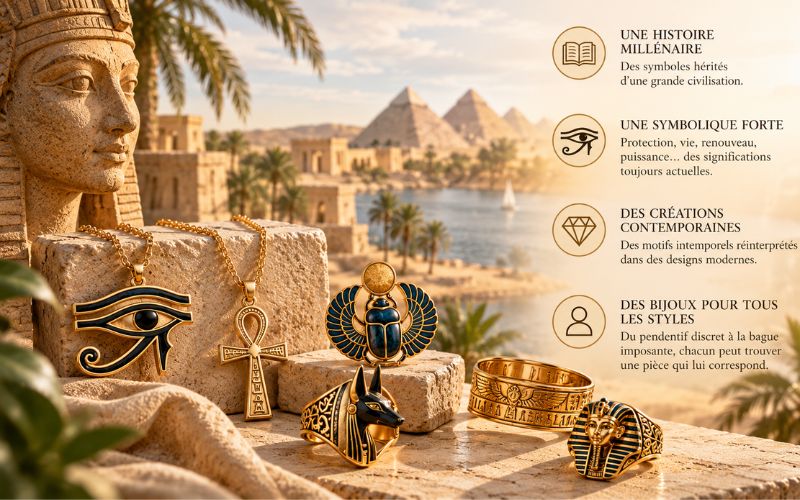
Jewelry inspired by ancient Egypt owes a large part of its uniqueness to the power of its symbols. Behind the Eye of Horus, the Ankh, or the scarab lie representations inherited from a civilization thousands of years old.
Reinterpreted in contemporary creations, these motifs today allow us to combine history, symbolism, and aesthetics. From the subtle pendant to the bolder ring, everyone can choose a piece that matches their style while discovering the meaning of the symbol it represents.
Related tags
Comments
Comments are coming soon.