Mushroom Leather: The Ecological Alternative Revolutionizing Fashion
Discover how mushroom leather reduces the luxury fashion industry's carbon footprint, offering a nature-friendly solution.
Aurelia
22 March 2025
The luxury fashion industry is undergoing a major transformation with the emergence of alternative, more sustainable, and eco-friendly materials. Among these innovative materials, mushroom leather (or mycelium) is generating growing interest. Cultivated in laboratories from mushrooms, it is gradually establishing itself as an ecological and ethical alternative to traditional leather.
« Mushroom leather embodies the future of fashion, where innovation and sustainability meet to offer an ethical, elegant, and planet-friendly alternative. »
The luxury fashion industry is undergoing a major transformation with the emergence of alternative, more sustainable, and eco-friendly materials. Among these innovative materials, mushroom leather (or mycelium) is generating growing interest. Cultivated in laboratories from mushrooms, it is gradually establishing itself as an ecological and ethical alternative to traditional leather. Through this article, let us dive into the world of mushroom leather, its environmental benefits, its applications in luxury fashion, and its promises for the future of the industry.
What is mushroom leather?
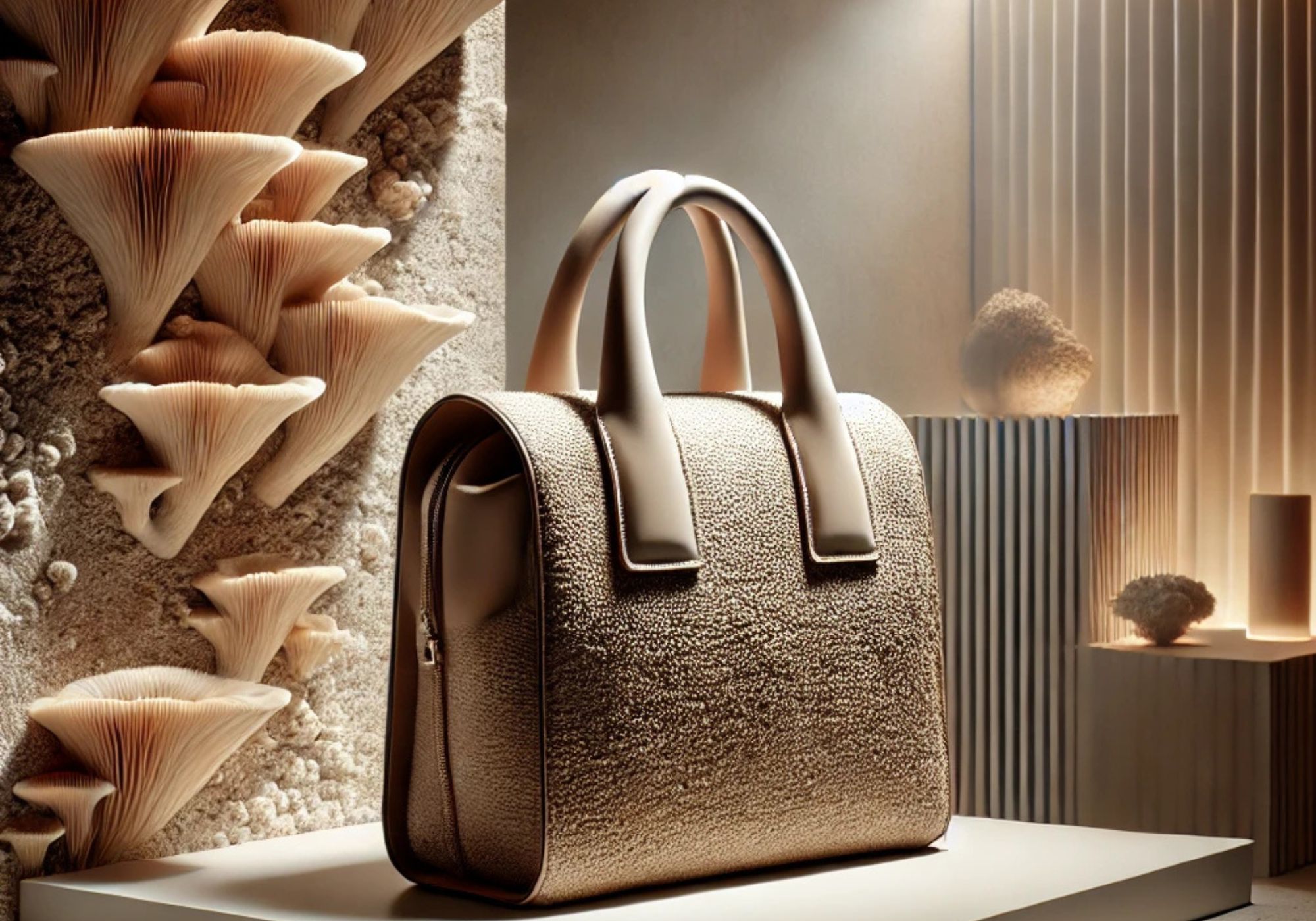
Mushroom leather is an organic material made from mycelium, the vegetative part of fungi. Mycelium develops into a filamentous structure that can be harvested, processed, and transformed into a flexible and durable leather, similar to traditional animal leather. Unlike conventional leather production, animal farming and its associated polluting processes are avoided, making mushroom leather a more environmentally friendly solution.
The manufacturing process of mushroom leather begins with the cultivation of mycelium on an organic substrate, such as agricultural waste. This requires optimal growing conditions with a temperature between 20°C and 27°C and high humidity (80-90%). In just a few weeks, the mycelium reaches a sufficient size to be harvested and transformed into a soft, durable leather.
The rise of mushroom leather in luxury fashion
Major luxury houses are increasingly turning to ecological and sustainable alternatives. Mushroom leather, due to its biodegradable nature and low CO₂ emissions, meets this growing demand for more environmentally conscious fashion.
Stella McCartney: pioneer in the use of mycelium
Designer Stella McCartney is one of the first to have integrated mushroom leather into her collections. In 2022, she launched her Frayme Mylo™ bag, made from Mylo™, a plant-based leather designed by the startup Bolt Threads, specialized in the development of sustainable materials. This bag embodies McCartney’s commitment to ethical and eco-friendly fashion, without compromising on luxury and aesthetics.
Mylo™ is made from mycelium grown under controlled conditions, thereby reducing the carbon footprint compared to animal leather. This material offers a flexibility and texture similar to those of traditional leather, while being entirely biodegradable at the end of its lifecycle.
Hermès and Sylvania leather: an innovative partnership
Hermès, one of the most emblematic luxury houses, has also adopted mushroom leather in its collections. In collaboration with MycoWorks, a startup specializing in mycelium leather manufacturing, Hermès launched Sylvania leather, a sustainable material used to create pieces like the Victoria bag. This partnership highlights the house’s desire to blend tradition with ecological innovation.
Sylvania leather, much like Stella McCartney’s Mylo™, offers an alternative to animal leather while maintaining the quality and durability expected of a Hermès product. Thanks to this collaboration, mycelium is beginning to take an important place in luxury leather goods, reducing the ecological impact of leather production.
Which Hermès bag is increasing in value in 2025?
They are currently the most coveted handbags in the world. In 2024, the Hermès Birkin bag is one of the most sought-after and appreciated by collectors, and certainly one of the most desired bags by fashionistas.
The environmental benefits of mushroom leather
One of the main assets of mushroom leather lies in its low ecological footprint. Here are some of its major benefits:
Related to this topic:
- Selena Gomez pregnant? she inspires maternity fashion for 2026
- 8 wedding trends for 2026–2027: style and inspirations
- Mother's Day: gift ideas, traditions around the world
1. A reduced carbon footprint
Traditional leather production, especially animal leather, is responsible for a large quantity of greenhouse gas emissions. According to some estimates, producing 1 kg of leather can emit up to 110 kg of CO₂. In contrast, mushroom leather has a much lower carbon footprint. Its production requires fewer natural resources and generates less pollution, making it an increasingly popular choice in a fashion industry seeking sustainable solutions.
2. Biodegradability and durability
Unlike synthetic leathers made from plastics and other non-biodegradable materials, mushroom leather is 100% biodegradable. At the end of its lifecycle, it decomposes naturally, thereby reducing environmental pollution.
Moreover, mushroom leather is extremely durable. Through a special treatment, it is made resistant, flexible, and similar to animal leather, while remaining free of polluting chemicals used in traditional leather tanning.
3. Lower water and energy consumption
Traditional leather production requires a large amount of water and energy. In comparison, cultivating mycelium to make mushroom leather uses very little water, and the production itself is powered 100% by renewable energy in modern facilities. This helps reduce the ecological impact of manufacturing while maintaining high product quality.
Challenges and outlook for mushroom leather
Although promising, mushroom leather is not without challenges. Large-scale production remains relatively costly, which may limit its accessibility for all brands, even if costs are decreasing over time thanks to technological progress.
Furthermore, mushroom leather still needs to demonstrate that it can compete with animal leather in terms of long-term durability. However, current research shows that it is fully capable of meeting the demands of the luxury industry.
Mushroom leather represents a revolution in the field of ecological and sustainable materials for luxury fashion. Through initiatives like those of Stella McCartney and Hermès, mycelium leather is gradually carving out a place in the luxury universe, combining innovation, aesthetics, and respect for the environment. As the fashion industry continues to evolve, mushroom leather could well play a key role in reducing the sector's ecological impact, paving the way for a more ethical and responsible fashion.
Comments
Comments are coming soon.