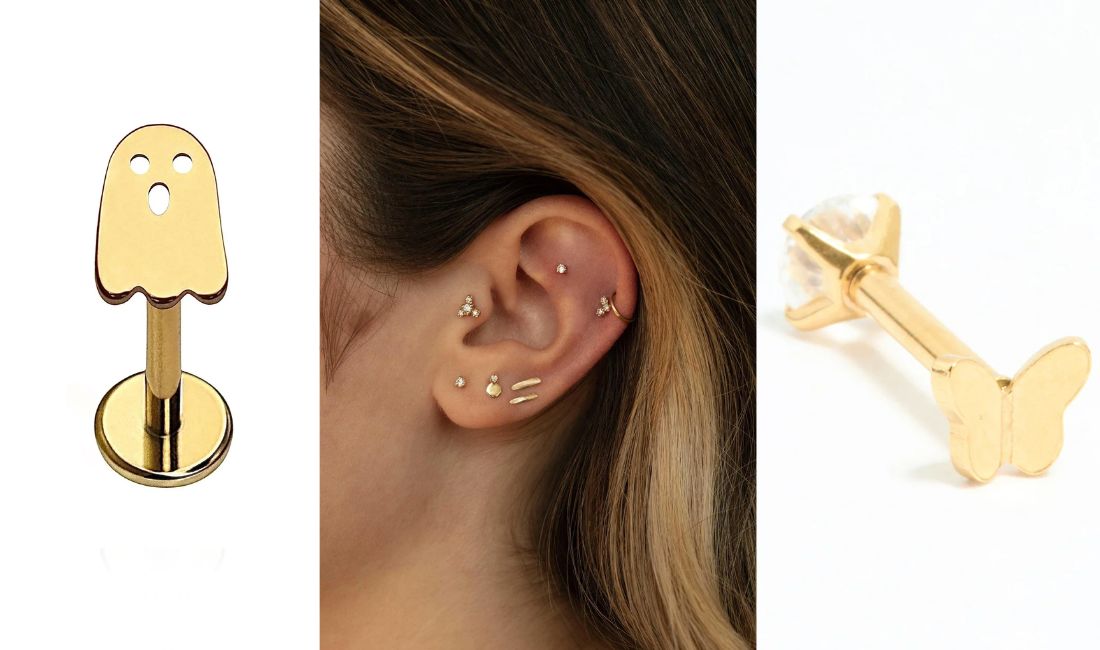
Micro-trend
Ear stack: compose your ear, how-to guide and 7 prices checked
Ear stack, or composed ear, is arriving in France: searches have almost tripled in a year. New York origin, composition method, healing times by location and seven ear cuffs priced from €25 to €169 to try without piercing.
This article contains affiliate links: if you buy after clicking, Orzyla may earn a commission at no extra cost to you.
Aurelia
18 November 2026
Key takeaways
- Ear stack refers to multiple pieces of jewelry worn on the same ear and conceived as a single composition, from the lobe to the cartilage.
- In France, Google searches for "ear stack" rose from 90 to 260 per month between November 2025 and October 2026.
- The style comes from "Curated Ear," an expression attributed to New York piercer Maria Tash, who opened her first studio in 1993.
- A lobe piercing heals in approximately six to eight weeks, a cartilage piercing in six to twelve months according to Cleveland Clinic.
- An ear cuff lets you try ear stack without piercing: our November 18, 2026 tracking ranges from €25 at Agatha to €169 in gold at Marc Orian.
Ear stack consists of wearing several pieces of jewelry on the same ear, from the lobe to the cartilage, to form an ensemble conceived as a single parure. In France, Google searches for "ear stack" rose from 90 per month in November 2025 to 260 in October 2026, according to Google Ads volumes tracked by Orzyla via DataForSEO.
What is an ear stack?
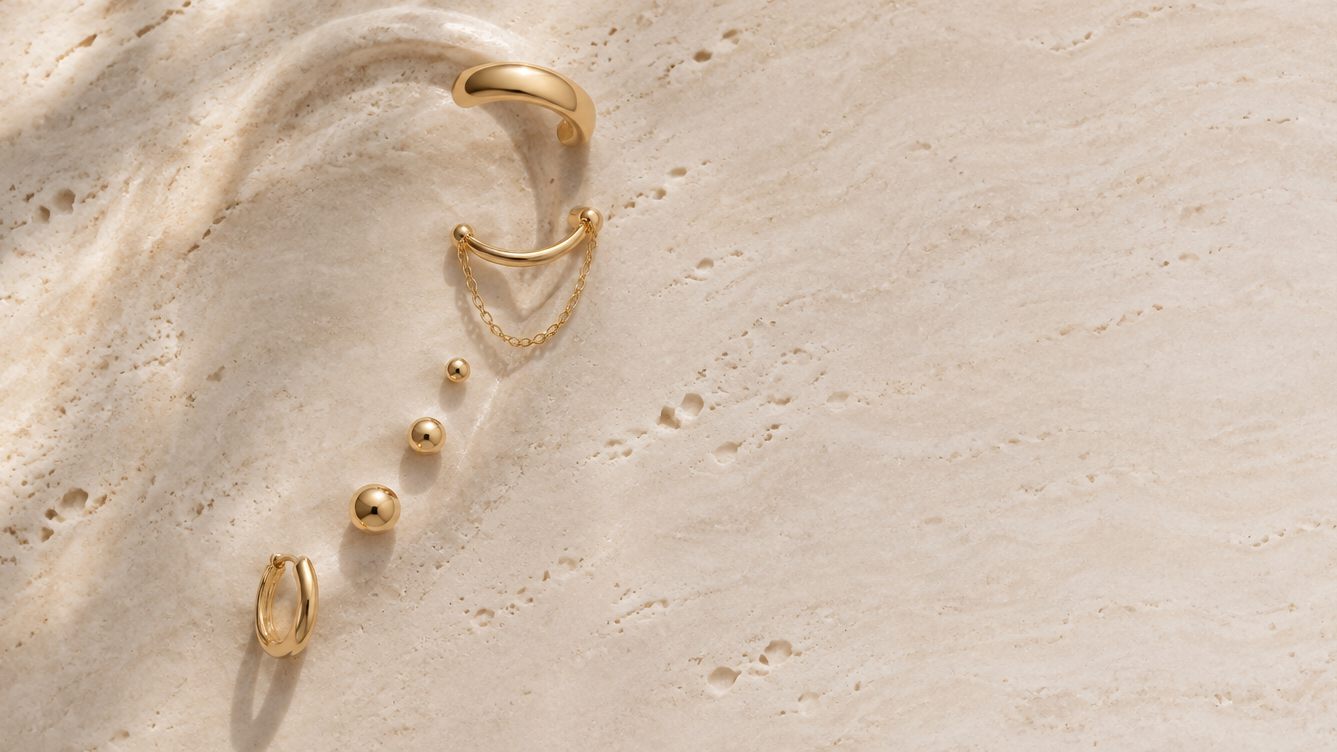
An ear stack is a composition: studs, rings and sometimes an ear cuff distributed on the ear according to a guiding principle (one metal, a decreasing size, a recurring motif). The English term comes from the verb "to stack," already used for rings and bracelets worn in accumulation.
It should not be confused with the ear cuff, which is a single piece: a piece of jewelry that slides over the edge of the ear without piercing. The ear cuff is often an element of the ear stack, not its synonym. A composed ear may have no ear cuff at all. More spectacular, the ear grillz covers the cartilage with a single piece.
From New York's "curated ear" to French searches
The gesture is ancient (the history of the earring is much longer), the name is recent. The trend has a name of origin: the "Curated Ear." American piercer and jeweler Maria Tash opened her first studio, Venus Modern Body Art, in 1993 in Manhattan's East Village, and the expression is attributed to her to describe an ear pierced "with aesthetic intention, under the direction of piercing experts," according to her Wikipedia entry. In 2019, The Guardian presented her as one of the first to champion this style and quoted her definition: a philosophy of "layering jewelry on the ear."
The same article noted, according to American studio Infinite Body Piercing, the five most requested locations in 2017: the lobe, then the helix, tragus, conch and forward helix. This remains the basis for most compositions.
In France, the word is now arriving. Here are the monthly Google search volumes we tracked on November 18, 2026:
| Search query (France) | November 2025 | October 2026 |
|---|---|---|
| ear stack | 90 | 260 |
| ear cuff women | 1,600 | 5,400 |
| ear cuff agatha | 390 | 1,300 |
| earcuff hermes | 50 | 210 |
| ear cuff | 18,100 | 14,800 |
This table shows two things. The term "ear stack" remains niche but has nearly tripled in a year, with steady growth since summer. And the ear cuff, already highly searched, is shifting toward brands: searches naming a house are growing faster than the generic term.
How to compose an ear stack?
Start with what you already have: one or two holes in the lobe are enough to begin. The method that works best can be summed up in a few steps.
- Choose a guiding principle. A single metal (all gold, all silver) gives a calm ensemble; mixing gold and silver works if it repeats on both ears.
- Make sizes decrease. The largest piece goes at the bottom of the lobe, the finest pieces go up toward the cartilage.
- Alternate shapes. A ring, a stud, then a ring: the eye reads a composition rather than a row.
- Test with an ear cuff. Before any new piercing, an ear cuff placed on the helix shows if you like the placement.
- Leave some empty space. An ear entirely covered reads poorly; empty space highlights the pieces.
Our advice: compose just one ear and leave the other almost bare. Asymmetry is the signature of the trend, and it limits the number of piercings.
Locations and their healing times
The lobe heals quickly, cartilage much more slowly. Cleveland Clinic indicates that a lobe piercing heals in approximately six to eight weeks, and you should allow six to twelve months for daith, rook, conch, helix and tragus, as cartilage has less blood supply (Cleveland Clinic, June 2025).
| Location | Area | Healing |
|---|---|---|
| Lobe | bottom of ear, soft tissue | 6 to 8 weeks |
| Helix | upper edge, cartilage | 6 to 12 months |
| Tragus | small bulge in front of canal | 6 to 12 months |
| Conch | central hollow, cartilage | 6 to 12 months |
| Rook | upper inner fold | 6 to 12 months |
| Daith | fold above canal | 6 to 12 months |
These timelines change your schedule: an ear stack is built over several months, one cartilage piercing after another. If your skin reacts to costume jewelry, also read our guide on metal allergies before choosing your pieces.
Cartilage piercing: needle rather than gun
In France, the Public Health Code regulates body piercing, but excludes from these rules earlobe and nose wing piercing performed with an ear-piercing gun (article R1311-1). For the gun, article R1311-8 requires a disposable element between the skin and the device, and sterile jewelry for placement.
For cartilage, Cleveland Clinic reminds us that guns are not always sterilized between uses and that the needle would cause less pain. Our position is simple: entrust the helix, tragus or conch to a piercer who works with a needle, never to a gun at a counter. For jewelry, the same source recommends 14-karat gold, medical-grade steel or titanium, and advises against alloys containing nickel.
Aftercare comes down to few steps: clean the front and back twice daily with water and soap, don't rotate the jewelry during healing, avoid pools and hot tubs. Redness that won't go away, discharge or returning pain justify a consultation.
Ear cuff: seven prices checked to compose without piercing
The ear cuff is the simplest entry point: it goes on without a hole and comes off in the evening. We tracked these prices on November 18, 2026 in the ear cuff sections of brand websites.
| Piece | Material | Price tracked 11/18/2026 |
|---|---|---|
| Rivoli gold ear cuff, Agatha | gold-plated brass 750/1000 | €25 |
| Leo gold ear cuff, Agatha | stainless steel | €30 |
| Pierre Batignolles ear cuff, Agatha | natural stone, gold | €50 |
| Karoly silver ear jewel, Marc Orian | silver, cubic zirconia | €34.30 |
| Silohe single ear jewel, Histoire d'Or | gold-plated yellow | €35 |
| Faris yellow gold ear jewel, Histoire d'Or | yellow gold 375/1000, cubic zirconia | €105 |
| Sparkle yellow gold ear jewel, Marc Orian | yellow gold, cubic zirconia | €169 |
Agatha describes its Rivoli and Leo models as piercing imitations: they suit unpierced ears. Their limitation lies in the material: these are costume jewelry pieces in gold-plated brass or steel, to wear occasionally if your skin reacts to metals. For a piece worn daily on healed cartilage, we would choose gold: €105 at Histoire d'Or remains the entry price from our tracking.
To go further on closures, our article on flat-back earrings explains the advantage of this system on cartilage.
Frequently asked questions
What is an ear cuff?
An ear cuff is a piece of jewelry that slides over the edge of the ear, most often on the helix, without piercing. It stays on through pressure and comes off like a ring. In an ear stack, it plays the role of a fake cartilage piercing: it complements the lobe studs and rings without requiring a new hole or healing time.
Can you wear an ear cuff on an unpierced ear?
Yes, that's its purpose. Agatha, for example, describes its Rivoli and Leo ear cuffs as piercing imitations, sold for €25 and €30 on November 18, 2026. Simply slide it onto the thin part of the ear's edge then slide it to the desired location, without tightening the metal excessively.
How long does it take for a helix piercing to heal?
Allow six to twelve months for a helix, as well as for the tragus, conch, rook or daith, according to Cleveland Clinic. Cartilage has less blood supply than the lobe, which heals in approximately six to eight weeks. During this time, clean twice daily and don't change the jewelry.
Can an ear cuff be worn by men too?
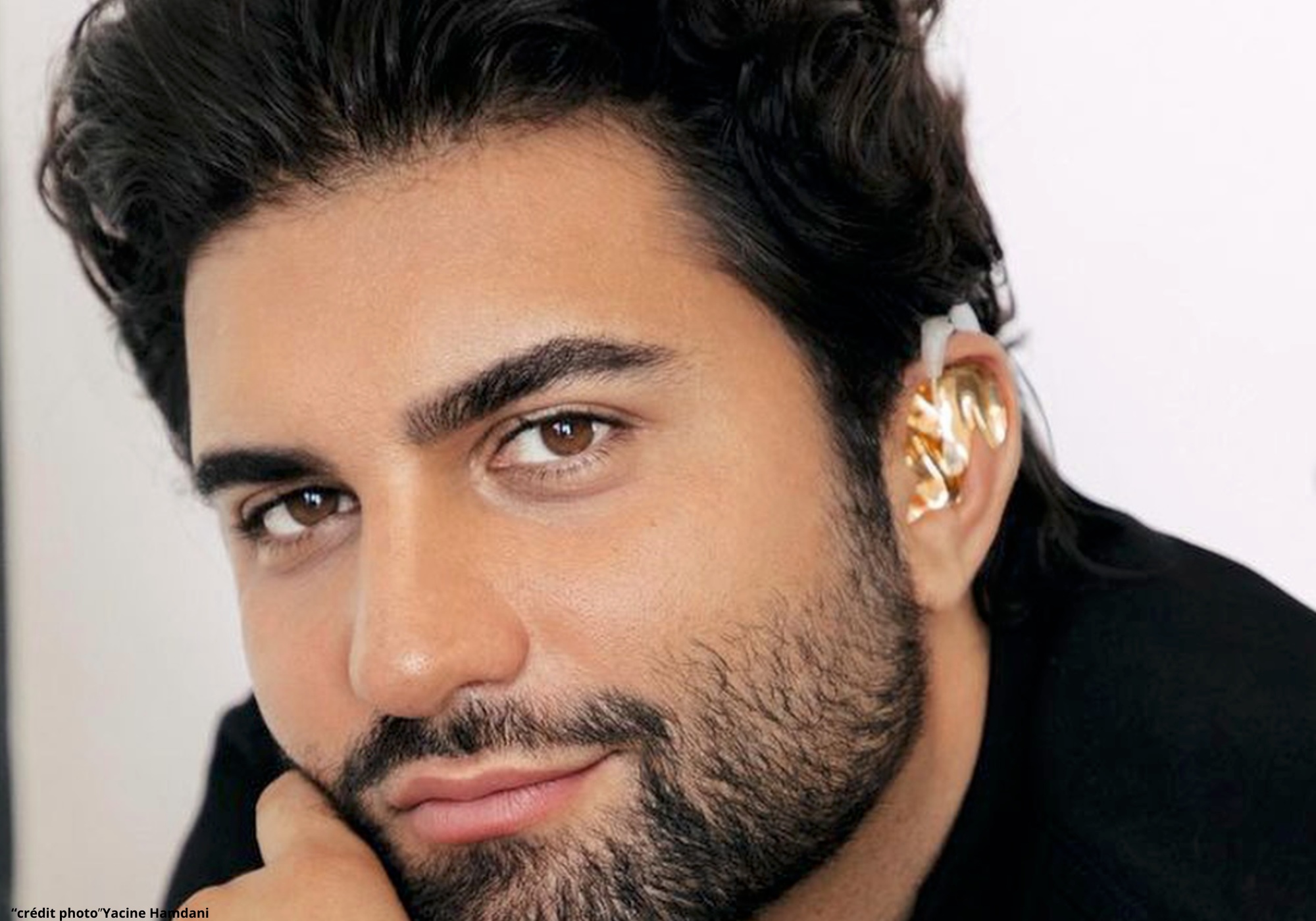
Yes. The jewelry has no gender and the search "ear cuff men" is searched monthly in France. For a male ear stack, a thin ring on the lobe and a solid ear cuff in silver or gold on the helix are enough: the composition remains readable without multiplying pieces.
What metal should you choose for an ear stack on sensitive skin?
For a piercing, Cleveland Clinic recommends 14-karat gold, medical-grade steel or titanium, and advises against alloys containing nickel, common in costume jewelry. Keep gold-plated brass and common steel for ear cuffs worn occasionally, which don't go through the skin.
Sources
- Volumes de recherche Google Ads en France (ear stack, ear cuff), relevé Orzyla du 18 novembre 2026 via l'API DataForSEO
- Maria Tash
- The curated ear: why delicate, decorative piercings are the new tattoos
- Ear Piercing 101: Healing, Hurting, Cleaning and More
- Code de la santé publique, article R1311-1
- Code de la santé publique, article R1311-8
- Earcuff Rivoli doré (25 €)
- Earcuff Leo doré (30 €)
- Earcuffs Agatha (Pierre Batignolles, 50 €)
- Ear cuffs Histoire d'Or (Silohe 35 €, Faris 105 €)
- Ear cuffs Marc Orian (Karoly 34,30 €, Sparkle 169 €)
Related tags
Comments
Comments are coming soon.