✦ Key takeaways
- According to the Canadian Conservation Institute, silver tarnish is mainly black silver sulfide, formed by sulfur compounds in the air: cleaning treats it, cleansing does not.
- According to the Canadian Conservation Institute, each polishing removes some of the underlying silver along with the tarnish layer.
- The GIA indicates that the color of some amethysts may fade after prolonged exposure to intense light, making sun recharging risky.
- For opal, the GIA specifies that the heat of intense light can cause cracks, and that warm soapy water is the only safe cleaning method.
- Cleansing and recharging jewelry are matters of spiritual belief; only cleaning produces an effect that can be observed on the jewelry.
Contents 6 sections
- Cleaning acts on the material, cleansing on the meaning you give to the jewelry
- The recommended order: clean, then cleanse, then recharge
- Goal, method, frequency: the three gestures side by side
- The mistakes that damage jewelry, in cleaning as in ritual
- A jeweler takes over when the stone is treated or fragile
- A simple routine for jewelry that arrives at your home
Cleaning your jewelry removes dirt, sebum and tarnish: it is physical maintenance, whose effect is visible. Jewelry cleansing is a spiritual practice aimed at an energy whose existence remains a belief. The most logical order for those who practice both: clean first, cleanse next, recharge last.
Cleaning acts on the material, cleansing on the meaning you give to the jewelry
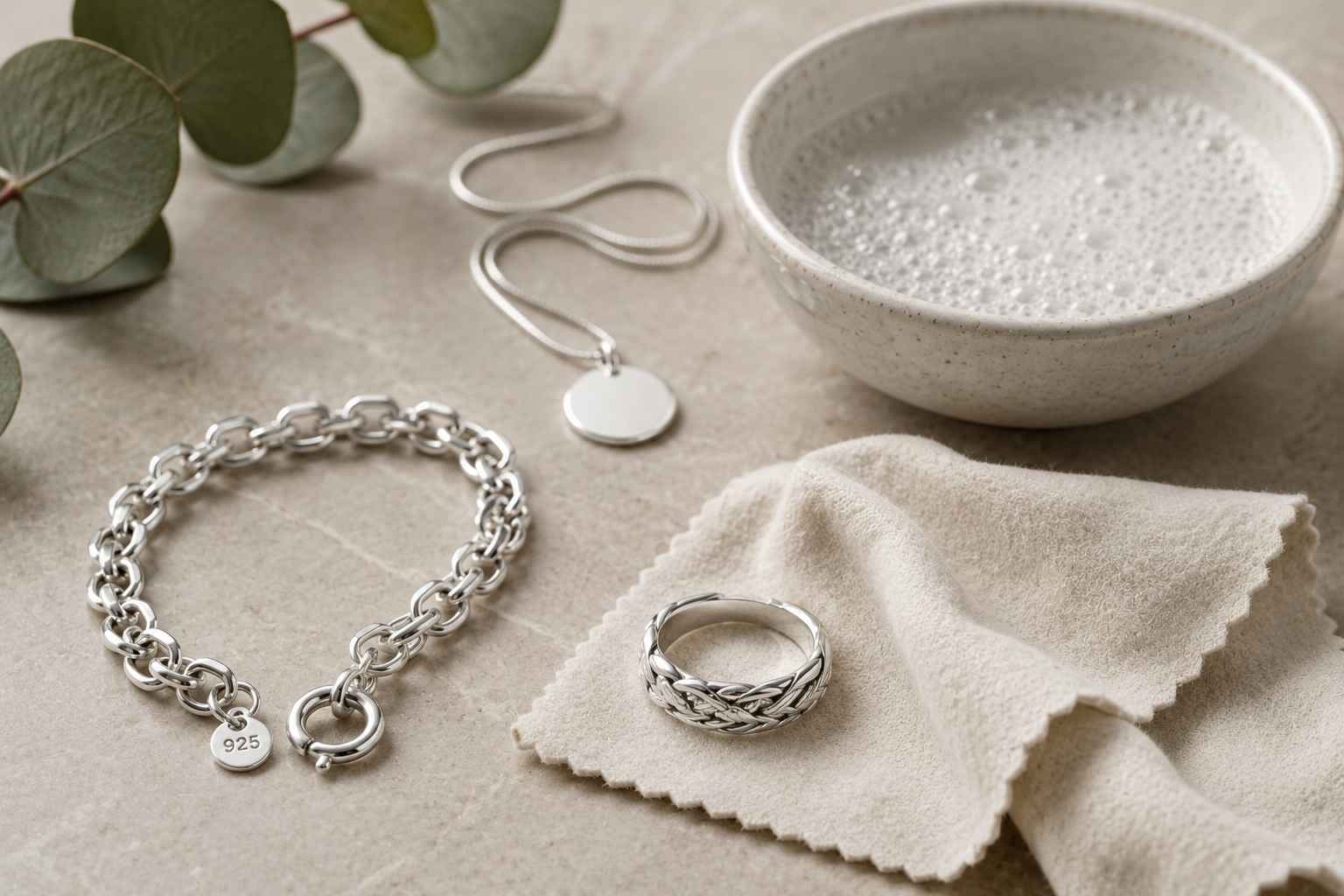
Jewelry cleaning deals with physical phenomena. A gold piece worn every day gets dirty: cream, soap and sebum lodge under stones and in the grooves of the setting. Silver, meanwhile, tarnishes. According to the Canadian Conservation Institute, this film is mainly black silver sulfide, formed by sulfur compounds present in the air, such as hydrogen sulfide. In both cases, the result of cleaning is visible to the naked eye.
Cleansing belongs to another realm. In esoteric traditions and crystal healing, a piece of jewelry would absorb energies, those of its wearer or the moments it has experienced, and the ritual would serve to release them. This is a belief, not a proven effect. What changes, for those who practice it, is the relationship to the object: a gifted, inherited or second-hand piece becomes theirs.
The confusion comes from vocabulary. In everyday language, "cleanse" sometimes serves as a synonym for "clean," and many online answers to the question "how to cleanse your jewelry" actually describe cleaning. The two gestures complement each other, but one does not replace the other.
The recommended order: clean, then cleanse, then recharge
- Clean first. Cleaning reveals the true state of the jewelry: a stone that moves, a worn claw, a plated surface that fades. Jewelers of America proposes a simple test between two visits to the jeweler: touch the stone with a toothpick, and if it moves, have it tightened. A ritual, meanwhile, removes no dirt.
- Cleanse next. According to tradition, cleansing frees the jewelry from accumulated energies. The methods (fumigation, moonlight, salt, sound) are detailed in our guide on jewelry cleansing and negative energies.
- Recharge last. Again according to this tradition, a piece of jewelry recharges once cleansed, as explained in our article on recharging your jewelry.
If you don't believe in cleansing, only the first step matters. It is enough to keep jewelry clean and in good condition.
Goal, method, frequency: the three gestures side by side
| Gesture | Goal | Common method | Frequency | Verifiable effect |
|---|---|---|---|---|
| Clean | Remove dirt, sebum and tarnish | Warm soapy water, soft brush, drying; for silver without stones, bath with aluminum contact | As soon as the jewelry appears dull, with regular checks at the jeweler | Yes, to the naked eye |
| Cleanse | According to tradition, free the jewelry from accumulated energies | Fumigation, moonlight, sound, salt placed next to the jewelry | Upon arrival of a piece (inherited, gifted, second-hand), then according to your practice | No, this is a matter of belief |
| Recharge | According to tradition, restore energy to the stone | Moonlight, geode, intention | After each cleansing | No, this is a matter of belief |
The aluminum contact bath is based on an electrochemical reaction described by the Canadian Conservation Institute: as long as the two metals touch, the aluminum corrodes instead of the silver. For gestures suited to each metal, follow our method for cleaning your jewelry according to the metal.
The mistakes that damage jewelry, in cleaning as in ritual
Several cleansing or recharging rituals expose jewelry to sun, water or salt. Some stones tolerate this poorly. The precautions below come from care sheets from the Gemological Institute of America (GIA).
- Leaving an amethyst in the sun to recharge it. The GIA notes that the color of some amethysts may fade after prolonged exposure to intense light, and that a sudden temperature change can fracture it.
- Placing an opal in direct sunlight. The heat from intense light can cause cracks in it, and high heat or thermal shock can fracture it. To clean it, the GIA only recommends warm soapy water.
- Submerging a pearl in a bath. The pearl fears many chemicals and all acids, including hairspray, perfume, cosmetics and perspiration. It never goes through ultrasonic or steam cleaning, and the heat from intense light can dehydrate its nacre.
- Heating an emerald. Heat can enlarge its fissures. The GIA recalls that, by some estimates, 90% or more of emeralds have filled fissures.
- Exposing turquoise to cosmetics. It can discolor when in contact with chemicals, cosmetics, sebum or perspiration, and should never be steam or ultrasonic cleaned.
- Using an ultrasonic or steam cleaner at home. According to the GIA, these devices can loosen stones in their setting. Professionals check that stones are secure before using them.
- Polishing silver too often. The Canadian Conservation Institute specifies that polishing removes some of the underlying silver along with the tarnish layer.
For a salt ritual, the safest version is to place the jewelry next to the bowl, never in it, especially if it has a pearl, opal or turquoise.
A jeweler takes over when the stone is treated or fragile
Some cleaning is not done at home. This is the case with clogged pavé, a stone that moves or a gemstone whose treatments you are unaware of. The GIA advises against ultrasonic cleaning for a stone whose fissures have been filled, for organic materials (pearl, coral, amber, jet, shell cameo) and for gems sensitive to heat such as tanzanite, moonstone, opal or topaz, treated or not. On a diamond with filled fissures, steam, acid or ultrasound can damage the filling, which will not return to colorless if it blackens. Tell the jeweler of any known treatment before they work on the piece.
A simple routine for jewelry that arrives at your home
A gifted, inherited or second-hand piece lends itself well to this sequence. For the case of an antique ring, with checking the claws and transformation choices, see our guide for cleansing an inherited or second-hand ring.
- Check that stones are secure (toothpick test) and, if in doubt, visit a jeweler.
- Clean the jewelry with warm soapy water and a soft brush, or follow the method specific to its metal.
- Dry it with a soft cloth.
- If you practice cleansing, choose a method that its stone tolerates.
- Recharge it next, according to the same tradition.
- Store it separately. For silver, the Canadian Conservation Institute recommends polyethylene bags to limit tarnishing.
Daily habits (removing jewelry before sports, putting it on after perfume) are covered in our guide on jewelry care.
Frequently asked questions
What is the difference between cleansing and cleaning jewelry? +
Cleaning jewelry removes dirt, sebum and tarnish: it is physical maintenance whose result is visible. Cleansing jewelry is a spiritual practice, rooted in esoteric traditions and crystal healing, aimed at freeing the jewelry from accumulated energies. Its effect is a matter of belief.
Should you clean jewelry before cleansing it? +
Yes, this is the most logical order. Cleaning reveals the state of the jewelry (stone that moves, worn claw) and removes dirt, which no ritual does. According to tradition, cleansing comes next, then recharging.
How often should you clean your jewelry? +
It depends on wear and metal. Jewelry worn daily gets dirty faster than jewelry stored away. Clean it as soon as it appears dull, with warm soapy water, and have it checked regularly by a jeweler, as Jewelers of America recommend. For silver, space out polishing, which removes a bit of metal each time.
Can you cleanse or recharge jewelry in the sun? +
Not with all stones. The GIA notes that the color of some amethysts may fade under prolonged intense light, that the heat of intense light can crack an opal and dehydrate a pearl's nacre. For these stones, prefer a ritual without exposure, such as sound or intention.
Does salt damage jewelry? +
The GIA does not specifically mention salt, but reminds that pearls fear many chemicals and that turquoise can discolor when in contact with chemicals. For safety, if you follow a salt ritual, place the jewelry next to the bowl rather than in it.
Does jewelry cleansing have a proven effect? +
No. Cleansing is a spiritual practice: the idea that jewelry retains the energy of its wearers is a matter of belief, not a proven effect. However, many people find in it a ritual that helps them make an inherited or second-hand piece their own.
Sources
- Silver, Care and Tarnish Removal (CCI Notes 9/7)
- Repairs
- Amethyst Care and Cleaning Guide
- Opal Care and Cleaning Guide
- Pearl Care and Cleaning Guide
- Emerald Care and Cleaning Guide
- Turquoise Care and Cleaning Guide
- Diamond Care and Cleaning Guide
- Gems and Ultrasonic Cleaners
- How Diamond Treatments Can Impact Color, Clarity and Value of a Diamond