✦ Key takeaways
- Solid gold (750 millesimal), stainless steel and titanium withstand showering, provided they are rinsed with clear water and dried.
- Gold-plated (3 microns minimum), vermeil (5 microns) and gold-finished (less than 3 microns) wear from soap and friction: remove them before showering.
- Pool chlorine can attack gold alloys, according to the GIA: remove your fine jewelry before swimming.
- Pearls, opal, emerald and turquoise fear heat, cosmetics and chemical products, regardless of the metal of the setting.
- Jewelry worn every day is thoroughly cleaned every two weeks and checked once a year, as Pandora recommends.
Contents 9 sections
- The table: shower, pool and sea by material
- Solid gold: showering yes, chlorine no
- Gold-plated, vermeil and gold-finished: showering wears down the gold layer
- 925 silver: no soapy water daily
- Stainless steel and titanium: the true "shower" metals
- Stones that don't withstand showering
- The 5-step routine if you keep jewelry in the shower
- Special cases
- Mistakes to avoid
Can you shower with your jewelry? Yes for solid gold, titanium and stainless steel, provided you rinse and dry. No for gold-plated, gold-finished, pearls, opal and emerald: soap, heat and cosmetic products wear down the gold layer or damage the stone. Chlorinated pools and the sea are to be avoided for almost all.
The answer therefore depends less on the water than on the material of the jewelry and what comes with it in the shower: shower gel, shampoo, hot water, friction. All brands say the same thing. Pandora advises removing your jewelry before showering, swimming or sleeping, and Swarovski before washing your hands, swimming or exercising. Here, material by material, is what each one really can handle.
The table: shower, pool and sea by material
This table crosses the legal thresholds of the DGCCRF (gold fineness and minimum gold layer thickness) with the maintenance recommendations of the Gemological Institute of America (GIA), the American gemological laboratory, and manufacturers. First find the hallmark or mention on the label, then read the corresponding line.
| Material (legal mention) | Shower | Chlorinated pool | Sea | Why |
|---|---|---|---|---|
| Gold 750 millesimal (18 carat) | Possible, rinse and dry | No | Rinse with clear water | 75% pure gold; chlorine can attack gold alloys (GIA) |
| Gold 585 or 375 millesimal (14 and 9 carat) | Possible, but best avoided daily | No | Rinse with clear water | 41.5% to 62.5% other metals in the alloy, more reactive |
| Silver 925 millesimal | Best avoided | No | No | Cosmetics and chemical products promote tarnishing (Pandora) |
| Vermeil (silver-gilt, 5 microns minimum) | No | No | No | Fine gold layer that wears with friction |
| Gold-plated (3 microns minimum) | No | No | No | 3 microns, or 0.003 mm of gold on a base metal |
| Gold-finished (less than 3 microns) | No | No | No | Even thinner layer than gold-plated |
| Stainless steel 316L | Yes | Rinse after | Rinse after | More than 10.5% chromium; salt and chlorine weaken the protective layer |
| Titanium | Yes | Yes, rinse after | Yes, rinse after | "Exceptional" corrosion resistance in seawater |
| Brass, copper, costume | No | No | No | Alloys that oxidize and can stain the skin |
Stones change everything: a 18-carat gold ring set with pearls or opal follows the stone's rules, not the metal's. We come back to this below.
Solid gold: showering yes, chlorine no
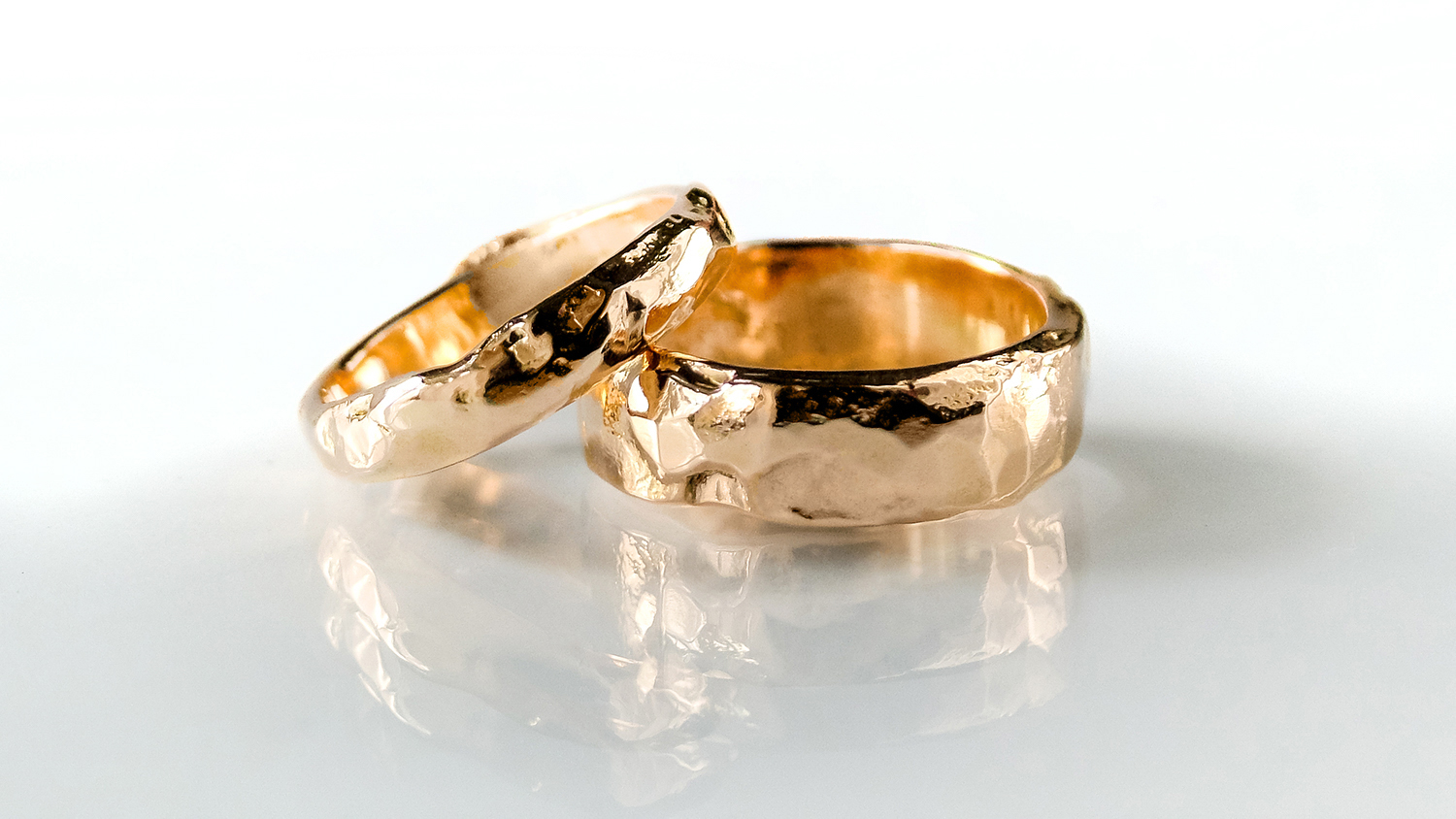
In France, only five fineness standards allow you to speak of "gold jewelry": 999, 916, 750, 585 and 375 millesimal, according to the DGCCRF fact sheet on jewelry labeling. A 750 millesimal piece contains 75% gold; a 375 millesimal contains only 37.5% gold, the rest being copper, silver or other alloy metals. The lower the gold content, the more the jewelry reacts to its environment.
Water alone does not damage gold. The risk comes from chlorine: the GIA recommends removing your fine jewelry before diving into a chlorinated pool and specifies that bleach, another chlorinated product, "can attack or damage gold alloys". In the shower, soap mainly leaves a dull film on the metal and in the prongs of the setting. An 18-carat gold wedding band that you never remove will withstand showering, but it will benefit from regular cleaning.
Don't know the fineness of your jewelry? Our guide to finding out if jewelry is gold from hallmarks helps you read it.
[tool:gold-value]
Gold-plated, vermeil and gold-finished: showering wears down the gold layer
French law sets a minimum thickness: 3 microns of gold for gold-plated or gold-filled, 5 microns for vermeil (silver coated with 750 millesimal gold at least). Below 3 microns, the jewelry can only be sold under the name "gold-finished", still according to the DGCCRF. Three microns is 0.003 millimeter.
A layer this thin doesn't resist long repeated friction from a washcloth or towel, nor the surfactants in shower gels. Once the gold is worn away, the base metal shows through and the skin can turn green. This is one of the causes of marks on the skin, detailed in our article on jewelry that turns skin green or black. So systematically remove gold-plated, vermeil and gold-finished before showering.
925 silver: no soapy water daily
Only 999, 925 and 800 millesimal fineness standards allow the name "silver". Silver tarnishing is caused by silver sulfide, a compound that forms when exposed to sulfur, as explained in the article Silver sulfide on Wikipedia. Clear water is not the main cause. However, Pandora reminds us that cosmetics and other chemical products can cause this tarnishing.
An occasional shower with a silver ring doesn't destroy it, but repetition tarnishes the metal and clogs the details. Keep soapy water for cleaning, not for wearing: our method for cleaning your jewelry metal by metal details the right amount.
Stainless steel and titanium: the true "shower" metals
Stainless steel, including the austenitic 316L grade, contains more than 10.5% chromium. This chromium forms a very thin oxide layer on the surface, called "passive", which protects the metal from rust, according to the article Stainless steel on Wikipedia. The same source clarifies that in case of strong exposure to salt or chlorine, this protection may not be sufficient in the long term. Showering therefore poses no problem; after the sea or pool, rinsing with clear water is a must.
Titanium goes further: its corrosion resistance is described as "exceptional" in seawater and in the human body by the article Titanium on Wikipedia, which classifies it, along with gold and platinum, among the most biocompatible metals. This is the material to choose for jewelry you never want to remove, like a soldered permanent bracelet.
Watch out for gold-plated steel: the gold color comes from a surface coating. The steel underneath resists water, but the coating wears like plating. If you're looking for a piece to wear in the shower, the women's steel jewelry selection from Histoire d'Or allows you to filter by material and type of jewelry.
Stones that don't withstand showering
Some gemstones fear hot water, soaps and cosmetics far more than the metal surrounding them. The GIA care sheets are clear.
- Pearls: they are attacked by many chemical products and by all acids, including hairspray, perfume, cosmetics and perspiration (GIA, pearls). A pearl necklace strung on silk should only be worn once the thread is completely dry.
- Opal: intense heat or sudden temperature change can fracture it (GIA, opal). A very hot shower followed by a cool room is to be avoided.
- Emerald: 90% or more of emeralds have fractures filled with oil or resin, which heat and chemical products can damage (GIA, emerald).
- Turquoise and porous stones: cosmetics can permanently damage their surface, according to the GIA.
Most colored stones are cleaned with lukewarm water and mild soap, according to the GIA: for a diamond, sapphire or ruby, water itself is not the problem. The risk is elsewhere: soap that accumulates under the stone steals its sparkle, and a weakened prong can slip without you noticing.
The 5-step routine if you keep jewelry in the shower
- Check the material: only solid gold, stainless steel and titanium without delicate stones are suitable.
- Avoid direct contact with shower gel and shampoo: rinse your hands before touching the jewelry.
- Rinse with lukewarm clear water at the end of the shower to remove soap residue.
- Dry by patting with a soft, non-lint cloth, especially between links and under the setting.
- Clean thoroughly every two weeks if you wear the jewelry every day, as Pandora recommends, and have the prongs checked once a year by a jeweler.
For complete cleaning, Swarovski recommends soaking in lukewarm water around 30°C with a few drops of neutral pH mild detergent, as recommended, a soak of two minutes at most, then rinsing with clear water. Boiling water can damage the jewelry.
Special cases
The wedding band you never remove. An 18-carat gold wedding band without a stone can withstand daily showering, provided it is rinsed and cleaned regularly. If it slides easily with soap, it's probably too big and risks going down the drain: our guide ring too big lists the solutions.
[tool:ring-size]
Piercing jewelry. A piercing in healing follows your piercer's instructions. Note that the regulations recalled by the DGCCRF require stems introduced into the body to release nickel below 0.2 µg per cm² per week, compared to 0.5 µg for jewelry in prolonged contact with the skin.
Hot baths, hammams and hot tubs. Prolonged heat and, for hot tubs, water often treated: remove all your jewelry, including gold.
Mistakes to avoid
- Rinsing jewelry over an open sink: the GIA recommends rinsing it in a glass of water, as you risk losing a loose stone, or even the entire jewelry, down the drain.
- Placing wet jewelry on the sink rim: plan a dry bowl, away from splashes.
- Using an ammonia or alcohol cleaner: Swarovski and the GIA advise against it for delicate stones and antique jewelry.
- Putting on perfume and cream after putting jewelry back on: Swarovski recommends making jewelry the last step of your routine.
- Believing that "gold-finished" jewelry is gold: below 3 microns, the gold layer disappears quickly in soapy water.
Frequently asked questions
Is it possible to swim with silver jewelry? +
Best avoided. Pandora and Swarovski advise removing their jewelry before swimming, and the GIA recommends removing fine jewelry before a chlorinated pool. After an accidental saltwater bath, rinse the jewelry with clear water and dry it with a soft cloth.
Does brass jewelry go in water? +
No. Brass is an alloy of copper and zinc that oxidizes when exposed to water and perspiration, and it can turn skin green. Plated brass jewelry also loses its gold layer faster in the shower.
Does steel jewelry blacken? +
Solid stainless steel rarely blackens: its chromium, above 10.5%, forms a protective layer against rust. However, strong exposure to salt or chlorine can exceed it, hence the benefit of rinsing after the sea or pool. Gold-plated steel, on the other hand, can lose its coating.
Can you shower with stainless steel jewelry? +
Yes. Stainless steel withstands shower water. Rinse it to remove soap and dry it, especially between links. If it's gold-plated, its surface coating will wear faster from soap and friction.
How do you wash silver jewelry? +
Soak it for at most two minutes in lukewarm water around 30°C with a few drops of neutral pH mild detergent, as Swarovski recommends, brush gently, rinse with clear water in a bowl then dry with a soft cloth.
Sources
- Étiquetage et sécurité des bijoux
- Tips on Caring for Jewelry
- Pearl Care and Cleaning Guide
- Opal Care and Cleaning Guide
- Emerald Care and Cleaning Guide
- Care Instructions
- How to clean Swarovski jewellery: care instructions
- Acier inoxydable
- Titane
- Sulfure d'argent
- Laiton
- File:Limestone - gold rings.jpg (W.carter, CC BY-SA 4.0)