Care and sensitive skin
Jewelry That Turns Skin Green or Black: 5 Causes and What to Do
A ring that turns your finger green, a necklace that blackens your neck: these marks almost always come from copper in the alloy, silver, or makeup, rarely from an allergy. Here's how to read the color of the mark, erase it, avoid it, and distinguish it from a real nickel reaction.
This article contains affiliate links: if you buy after clicking, Orzyla may earn a commission at no extra cost to you.
Aurelia
19 November 2026
Key takeaways
- A green mark comes from the copper in the jewelry, which reacts with sweat and air to form green salts; it washes off with soap and is not dangerous.
- A black mark comes from silver tarnish, or from gold particles torn off by makeup and mineral sunscreens (black dermographism).
- In France, gold-plated jewelry has less than 3 microns of gold, gold plating has at least 3 microns, and vermeil has at least 5 microns over silver.
- Itching, redness, or pimples signal an allergy, often to nickel, not just a simple mark: remove the jewelry and consult.
- Putting jewelry on after sunscreen and makeup, and removing it for sports and showers, prevents most marks.
Jewelry turns skin green when its copper, present in brass, bronze, 925 silver, or under worn plating, reacts with sweat and air: it forms green salts that deposit on the epidermis. A black mark usually comes from silver or metal particles torn away by makeup. Both wash off with soap.
The 5 causes in brief
- Copper from the alloy (brass, bronze, copper, low-karat gold) forms green salts when it comes into contact with sweat and air.
- Worn gold coating or plating allows the base metal, often brass, to touch the skin.
- Silver tarnish, made of silver and copper sulfides, leaves a gray or black shadow.
- Makeup and mineral sunscreen wear the metal through abrasion and deposit black particles: this is black dermographism.
- Sweat, creams, and soap accelerate all these reactions, which is why they vary from person to person and season to season.
Why does jewelry leave a green mark?
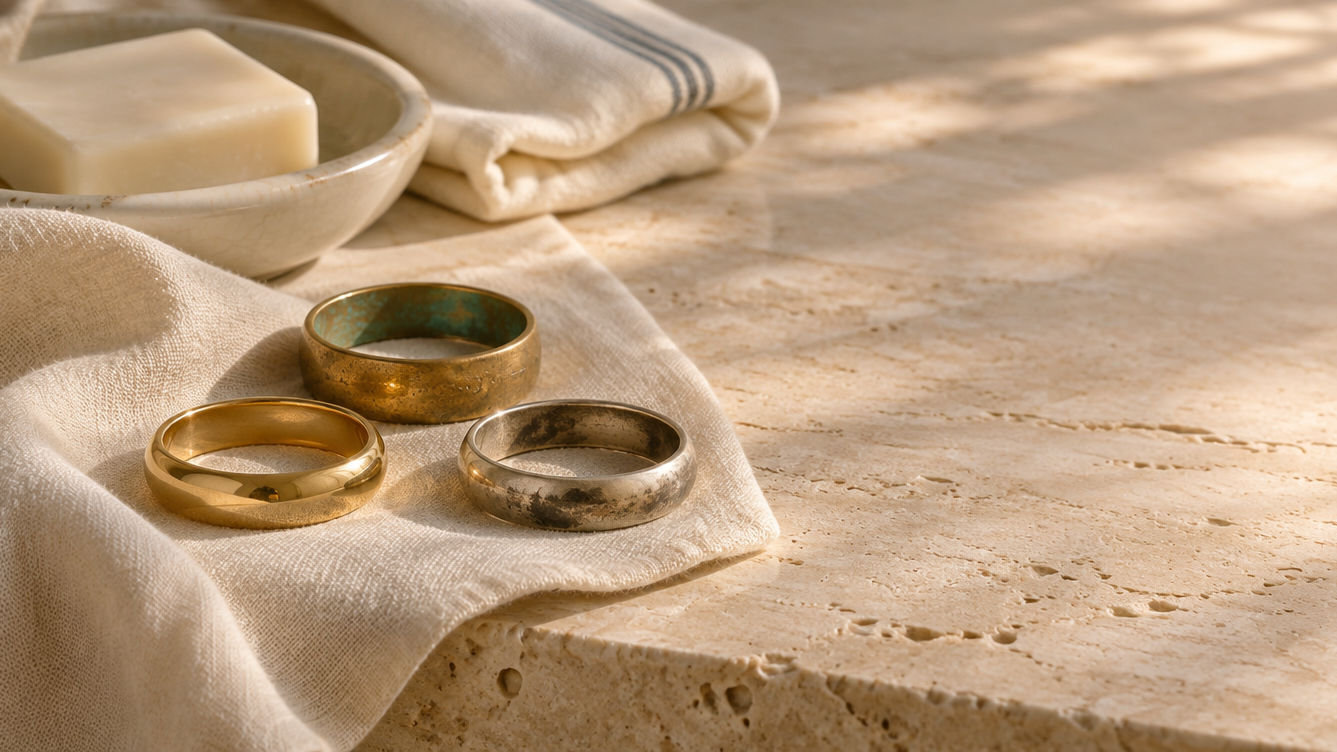
The culprit is almost always copper. The Royal Society of Chemistry explains that copper jewelry reacts with oxygen in the air and with sweat to form green-tinted compounds, which then transfer to the skin. These compounds don't all have exactly the same color: they range from blue to green and form a thin layer, or patina, particularly of copper carbonate.
Genesis HealthCare System, an American hospital network, emphasizes a point that is often misunderstood: it's not the price of the jewelry that matters, but the presence of copper. Whether it's pure copper or only mixed with other metals, the jewelry can react with sweat, cream, or soap and turn the skin green.
That's why the same ring turns a finger green in summer and not in winter, or affects one person and not their neighbor: the amount of sweat, the products applied to the skin, and the duration of wear change everything.
And when the mark is black or gray?
Silver that tarnishes
Silver blackens when it comes into contact with sulfur compounds. The Canadian Conservation Institute clarifies that pure silver tarnish is made of silver sulfide and that sterling silver tarnish also contains copper sulfide. It adds that sterling tarnishes faster than pure silver, and that the speed generally increases with copper content. This dark deposit can rub off on the skin and leave a gray shadow under a ring or bracelet.
Gold and makeup: black dermographism
More surprisingly, real gold can also leave a black mark. The dermatology journal Cutis published in 2026 the case of a 30-year-old woman who had dark spots on the angles of her jaw, appearing during the day and disappearing the next day. They only appeared when she wore her gold hoop earrings, while she applied mineral sunscreen daily.
The authors explain the mechanism: certain products such as makeup, sunscreens with zinc oxide or titanium dioxide, or toothpaste, wear the metal through abrasion. The fine particles torn off deposit on the skin and absorb light, hence the black color. This discoloration is not permanent and disappears as soon as you avoid contact between the product and the metal.
Reading the mark: the diagnostic table
This table cross-references the sources cited in the article to help you identify the cause based on the color of the mark.
| Color of the mark | Metal involved | Mechanism | Typical jewelry | What to do |
|---|---|---|---|---|
| Green or blue-green | Copper | Copper salts formed with sweat and air | Brass, bronze, copper, worn plating or gold plating | Wash the skin, dry the jewelry, isolate the inside with colorless varnish |
| Gray or black under silver jewelry | Silver and copper from the alloy | Silver and copper sulfides (tarnish) | 925 silver, 800 silver | Clean and polish the jewelry, store it away from air |
| Black under gold jewelry | Gold and alloy metals | Particles torn off by sunscreen or makeup (black dermographism) | Hoops, rings, gold chains | Put on jewelry after makeup, avoid contact with mineral sunscreen |
| Redness, itching, pimples | Often nickel | Contact allergy, not just a simple mark | Costume jewelry, clasps, earring posts | Remove the jewelry, consult a dermatologist |
Which jewelry turns green the most?
Brass and copper
Brass is an alloy of copper and zinc, widely used in costume jewelry. Without a coating, or as soon as it wears off, it's in direct contact with the skin and turns green easily. Copper bracelets worn for their supposed health benefits do the same: our article on copper jewelry returns to what can be expected from them.
Plating and gold coating that wear off
Gilded or plated jewelry often hides brass under its layer of gold. As long as the layer is intact, it acts as a barrier. When it wears out, in places that rub like the inside of a ring or the clasp of a chain, the base metal touches the skin. The DGCCRF sets the minimum thicknesses in France:
- Gold-plated: gold layer less than 3 microns.
- Gold plating: at least 3 microns of gold.
- Vermeil: at least 5 microns of gold at 750 fine or higher, applied to silver.
The less gold on the surface, the faster the base metal becomes exposed. The label therefore tells you how long a piece of jewelry will last before it turns green.
925 silver and low-karat gold
925 silver contains 92.5% silver and 7.5% other metals, usually copper. It blackens more than it turns green. For gold, a 9-karat piece contains only 375 thousandths of fine gold according to AuCOFFRE: the remaining 625 thousandths are other metals, including copper depending on the shade. Histoire d'Or reminds us that gold does not oxidize, unlike the metals that accompany it in the alloy. To verify the fineness of a piece of jewelry, follow our guide to tell if a piece of jewelry is gold by its hallmarks.
What to do: steps in order
- Erase the mark. Wash the skin with warm water and soap. A green mark usually comes off with washing; if not, it fades on its own within a few days once the jewelry is removed.
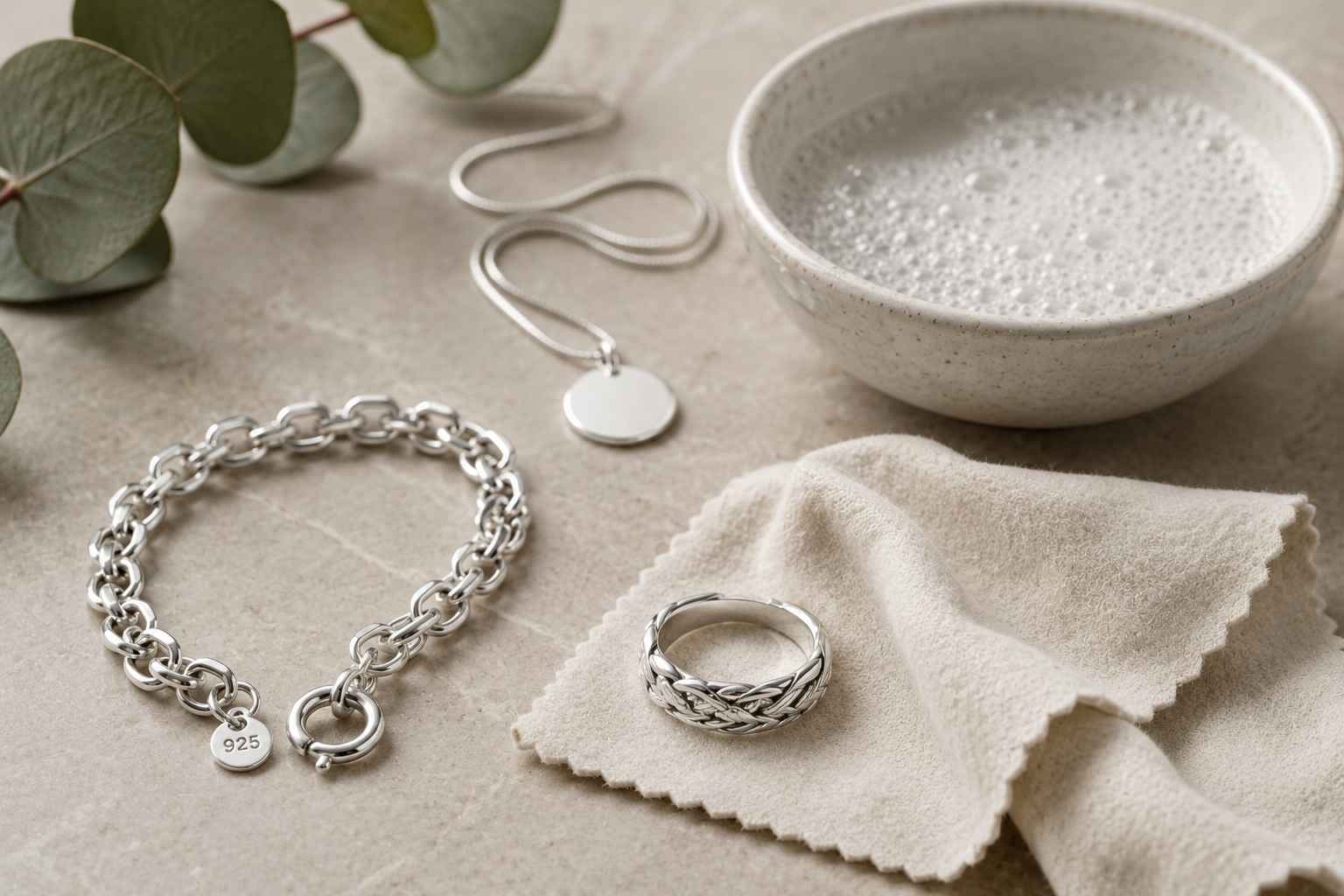
- Clean the jewelry. Remove the green patina or tarnish with the method suited to the metal, described in our guide to clean your silver, gold, or plated jewelry. For a charm bracelet, also see how to effectively clean a Pandora bracelet that has blackened.
- Dry before wearing again. Sweat, soap, and creams fuel the reaction: remove your jewelry for sports, showers, and dishwashing, and dry them before wearing.
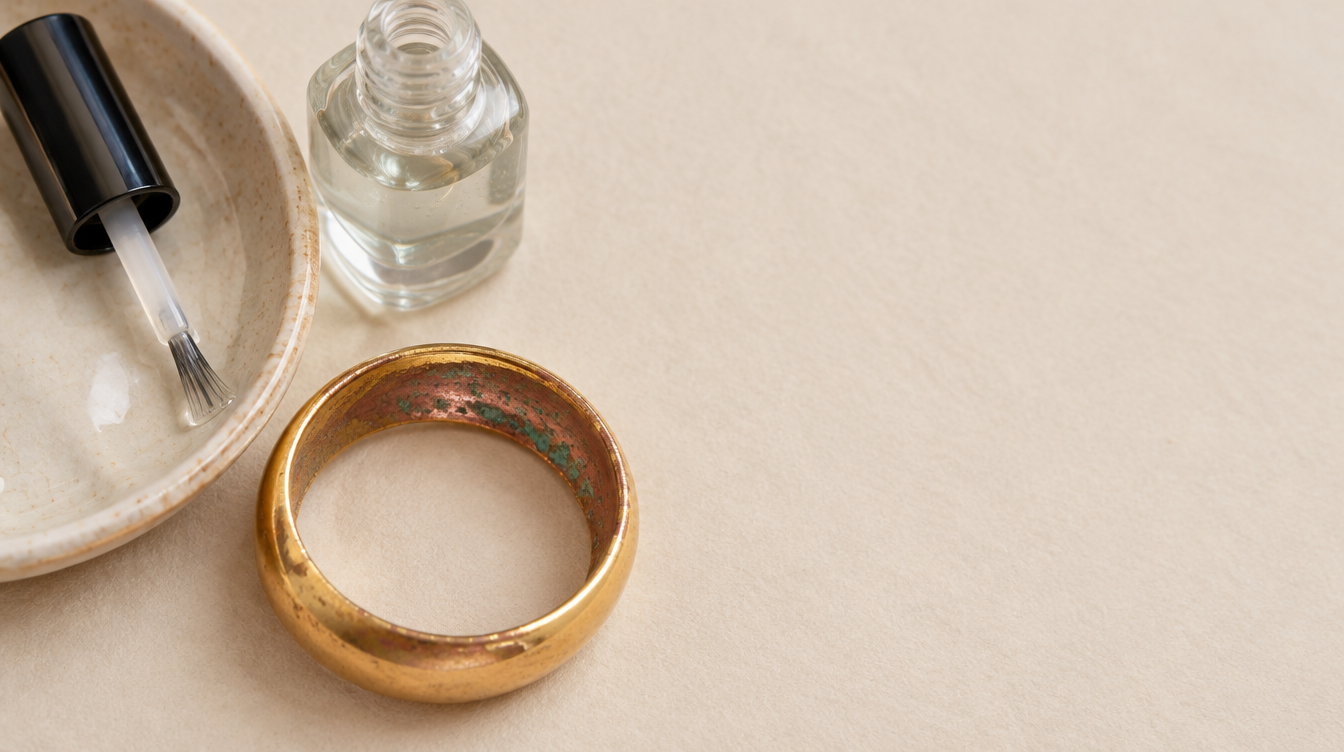
- Isolate costume jewelry. A layer of colorless nail polish inside a ring or on the back of a pendant forms a barrier between the metal and the skin. Renew it when it starts to chip.
- Change your routine order. Apply sunscreen, foundation, and powder, let them dry, then put on your earrings and necklaces. This is the direct solution to black dermographism.
Mark or allergy: how to tell the difference?
A green or black mark doesn't itch and doesn't swell. A contact allergy, on the other hand, manifests with itching, redness, small pimples, sometimes blisters. The metal most often involved is nickel, which has nothing to do with the color of the mark.
In the European Union, the REACH regulation (Annex XVII, entry 27) limits the nickel that a piece of jewelry can release: 0.5 µg/cm² per week for parts in direct and prolonged contact with the skin, and 0.2 µg/cm² per week for posts inserted in a piercing. This release is measured according to the EN 1811 standard, by placing the object for a week in artificial sweat. If a reaction occurs anyway, remove the jewelry and ask a dermatologist. Our guide on jewelry for sensitive skin details the best-tolerated metals.
Mistakes to avoid
- Conclude that the jewelry is fake. A black mark under a gold hoop may come from your sunscreen, not a counterfeit.
- Varnish fine jewelry. Varnish is an emergency solution for costume pieces; on a stone-set ring, it leaves residue around the stones.
- Keep costume jewelry in the shower. Soap and moisture perpetuate the copper reaction and make green appear faster.
- Confuse mark and allergy. Itching or eczema under jewelry is not solved with varnish: medical advice is needed.
Which jewelry to choose to stop skin from turning green?
For jewelry worn every day, favor solid metal with high fineness, such as 18-karat gold, or 925 silver if slight tarnish doesn't bother you: it generally doesn't turn green, but requires regular maintenance. You can compare women's silver jewelry from Histoire d'Or (affiliate link: Orzyla may receive a commission, at no extra cost to you). For a ring, measure your finger before changing style.
[tool:ring-size]
For costume jewelry, keep brass pieces for special occasions, remove them before sweating, and watch the inside of plated rings: an area of different color signals that the gold layer has worn off and that green won't be far behind.
Frequently asked questions
Can real gold darken the skin?
Yes. A gold piece can leave a black mark when makeup or a sunscreen with zinc oxide or titanium dioxide wears the metal: the particles torn off deposit on the skin. This black dermographism, described in Cutis journal in 2026, disappears as soon as you avoid contact between the product and the jewelry.
How do I remove a green mark left by a ring?
Simply wash the skin with warm water and soap: the mark usually comes off at first wash. Then clean the inside of the ring, dry it, and if it's costume jewelry, apply a layer of colorless varnish inside to isolate the metal.
Is jewelry that turns skin green necessarily fake?
No. The mark indicates the presence of copper, not a counterfeit. Brass, bronze, worn plating, but also 925 silver or low-karat gold contain copper. Only the hallmark indicates the true fineness of the precious metal.
Does 925 silver turn skin green?
Rarely. 925 silver contains 7.5% other metals, usually copper, but it tends to blacken more: its tarnish is made of silver and copper sulfides, which can leave a gray shadow on the skin.
Is a green mark an allergy?
No. A green mark doesn't itch and doesn't swell. A contact allergy, often to nickel, causes itching, redness, or pimples. In this case, remove the jewelry and consult a dermatologist.
Sources
- Why does copper jewellery turn your skin green?
- Comprendre comment ternissent les objets en argent
- Black Patches on the Angles of the Mandible (Ehlert, Delost, Delost), Cutis 2026;117(2):E12-E13
- Étiquetage et sécurité des bijoux
- REACH, annexe XVII, entrée 27 : restriction du nickel
- Nickel Directive
- Green skin from jewelry: What is it?
- Pourcentage de pureté de l'or et carats
- L'or : caractéristiques et propriétés
- Argent sterling
- Ce vernis transparent glissé dans vos bagues efface les traces vertes sur la peau
Related tags
Comments
Comments are coming soon.